What is Stonehenge?
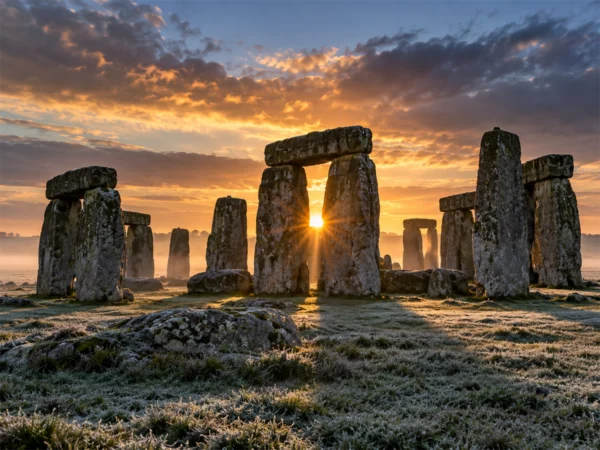
Stonehenge is a prehistoric megalithic monument on Salisbury Plain in Wiltshire, southern England. Huge stones up to 7 meters tall and weighing up to 25 tonnes stand in a circle, with horizontal lintels laid across their tops. In 1986 it was inscribed as a UNESCO World Heritage Site together with the nearby Avebury monuments.
When and how was it built?
Stonehenge was not built all at once but in stages over a long period. Around 3000 BC a circular ditch and bank were dug, and around 2500 BC huge sarsen stones from the local area and smaller bluestones were raised.
The bluestones are known to have been brought more than 200 kilometers from the Preseli Hills in Wales. In 2024, research also suggested that the central “Altar Stone” was most likely brought from northeastern Scotland. How the giant stones were transported and raised in an age without metal tools or the wheel remains one of its great mysteries.
What was it for?
The central axis of Stonehenge is aligned with the midsummer sunrise and the midwinter sunset. Theories therefore include an ancient observatory for tracking the sun, a temple for seasonal festivals, and a burial place for honoring ancestors. Cremated human remains have also been found at the site.
The medieval historian Geoffrey of Monmouth wrote that Merlin, the wizard of Arthurian legend, brought the stones from Ireland by magic. The idea that it was built by the Celtic priests known as druids also spread, but it is now known to be far older than the druids. Today crowds still gather to watch the sunrise at the summer solstice.
Stonehenge and ancient mysteries
Because of the mystery of how the stones were moved, Stonehenge is sometimes linked to lost super-civilizations or aliens (the ancient astronaut theory). As a mysterious megalithic site, it is often mentioned alongside the moai of Easter Island and the sunken Atlantis.