What is the Palenque sarcophagus?
Palenque is a Maya city ruin in the jungle of southern Mexico, a World Heritage site. In 1952, deep beneath its central pyramid, the Temple of the Inscriptions, the Mexican archaeologist Alberto Ruz Lhuillier discovered a secret staircase, and in the tomb chamber beyond it found a huge stone sarcophagus. Inside lay the remains of a king wearing a jade mask.
The king was K’inich Janaab Pakal, who ruled Palenque in the 7th century, and inscriptions show that he died in 683.
The “astronaut piloting a rocket” theory
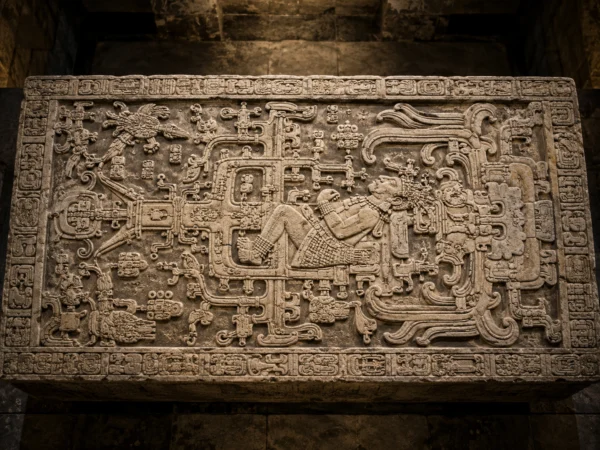
The sarcophagus lid is covered with fine carving. Because the central figure seems to lean forward operating some device, with flames shooting out behind, a theory arose that “it is an astronaut piloting a rocket.” It became world-famous when the Swiss writer Erich von Daniken presented it in his books in the 1960s, and it has been treated as a key piece of evidence for the ancient astronaut theory.
How Mayanists read it
Now that Maya writing has been largely deciphered, Mayanists read the carving as King Pakal at the moment of death, falling from the earthly world into the underworld, or being reborn from it. Rising above the king is the “world tree” that connects heaven, earth and the underworld, and beneath him is the open maw of an underworld monster. The part that looks like rocket exhaust is a mythological motif common in Maya art.
It has also been pointed out that it looks like a “rocket” only when viewed sideways instead of upright. Either way, this powerful carving remains one of the masterpieces of Maya art. Famous OOPArts are listed on the OOPArts page.