What is the Baghdad Battery?
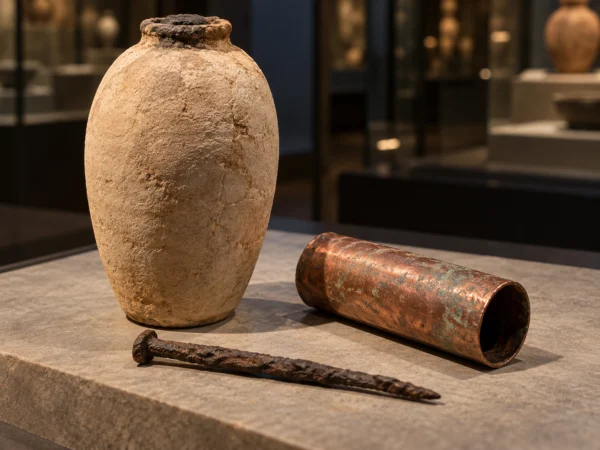
The Baghdad Battery is an unglazed clay jar about 13 centimeters tall, said to have been found in 1936 at a site called Khujut Rabu near Baghdad, Iraq. Inside the jar was a cylinder of rolled copper sheet, with an iron rod inserted into it. It is thought to date from the Parthian or Sasanian period (c. 3rd century BC to 7th century AD).
The “ancient battery” theory
In 1938, Wilhelm König, a German researcher working at the Iraq Museum, noticed that the jar’s structure closely resembled a battery and published a paper suggesting it might have been an ancient battery. If the jar were filled with an acidic liquid such as grape juice or vinegar, a current would flow between the copper and the iron.
Many replication experiments have confirmed that jars of the same design filled with such liquids produce a weak current of about 0.5 to 2 volts. König suggested it may have been used to electroplate objects with gold or silver.
Was it really a battery?
Most archaeologists are skeptical. No wires or conductors for carrying the current were found with it, and there is no clear evidence of ancient electroplating. Similar jars have been found at nearby sites as containers for scrolls, and the most likely explanation is that the Baghdad Battery was also a container for storing scrolls or similar items.
Producing a current, in other words, does not prove that ancient people used it as a battery. Another famous “electrical” OOPArt is the Dendera light. See our OOPArts overview for more famous examples.