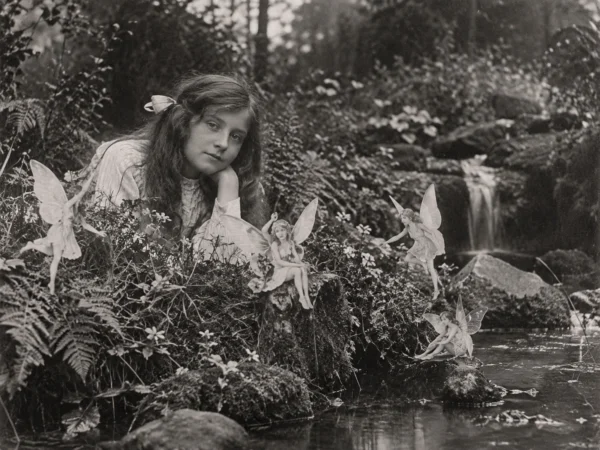
What are the Cottingley Fairies?
The Cottingley Fairies are photos taken in 1917 in the village of Cottingley in northern England by two cousins, Elsie Wright (then 16) and Frances Griffiths (then 9). They showed small winged fairies dancing in front of Frances beside a stream, among other scenes. The two continued taking pictures, and by 1920 five photos in all had been taken.
Presented as genuine by Conan Doyle
Passing through the hands of a member of the Theosophical Society, the photos came to the attention of the writer Arthur Conan Doyle, known as the creator of the great detective Sherlock Holmes. Doyle, who believed in Spiritualism, presented the photos in The Strand Magazine in 1920 as “evidence that fairies exist” and later published a book. Because some photography experts said there was “no sign of tampering such as double exposure,” a major controversy arose over whether they were real or fake.
A confession 66 years later
On the other hand, some suspected the photos because the fairies wore fashionable clothes and hairstyles and looked flat, like drawings. In 1983, Elsie and Frances, now elderly, confessed that the fairies were paper cut-outs drawn by copying illustrations from a children’s book, fixed to the grass with hatpins and photographed. Frances, however, is said to have insisted until her death that the fifth photo alone was genuine.
People who wanted to believe in fairies
The affair took place at a time when many people had lost family members in World War I and the wish to believe in an unseen world had grown strong. Today the photos are an essential example in the history of trick photography. For British fairy folklore, see also the entries on the fay and pixies.