What is a dorotabo?
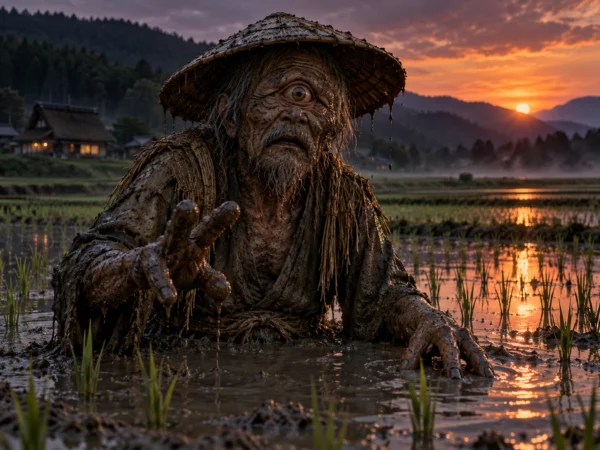
The dorotabo is a yokai that rises from a muddy rice field with only its upper body showing, crying “Give back my field, give back my field!” It is depicted as pitch black, with a single eye and only three fingers on each hand. The Edo-period artist Toriyama Sekien drew it in his 1781 yokai book Konjaku Hyakki Shui.
“Give back my field”: the story of the dorotabo
According to Sekien’s note, long ago an old man in the northern provinces bought rice fields little by little for his children and grandchildren and tilled them without rest in rain and wind. But when the old man died, his son neglected farming, drowned himself in drink and finally sold the fields to someone else. Then, night after night, a black one-eyed figure appeared in the fields, cursing, “Give back my field!” This was the dorotabo, it is said.
A yokai with a satirical message
The dorotabo story has not been found in other old texts or folk traditions, and it is thought to be a yokai created by Sekien. Many of Sekien’s yokai pictures contain wordplay or social satire, and the dorotabo can be read as a warning to prodigal sons who forget their ancestors’ hard work and lose their inheritance.
The dorotabo today
One interpretation holds that its three fingers show a figure missing two human fingers, said to represent wisdom and compassion. The dorotabo is depicted in modern manga and games as a vengeful yokai guarding fields. Other yokai drawn by Sekien include the kasha and the wanyudo.