What is the Face on Mars?
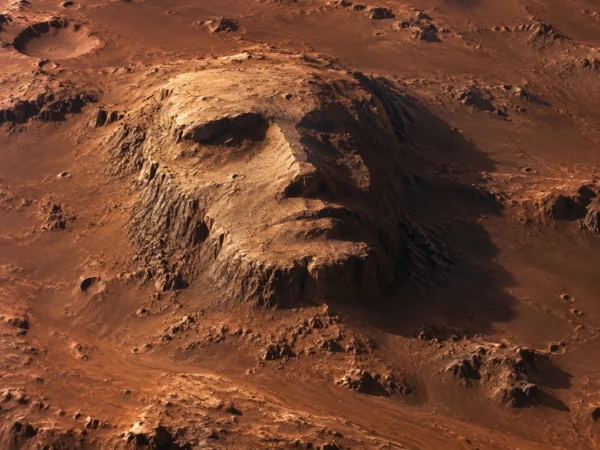
The Face on Mars is a rocky mesa that looks like a human face, found in a region called Cydonia in Mars’s northern hemisphere. It appeared in a photo taken on July 25, 1976, by NASA’s Mars probe Viking 1 while searching for a landing site. On a large mesa about 2 km across, there were shadows like eyes, a nose and a mouth, looking like a face gazing up at the sky.
The ancient civilization theory
When NASA released the photo, it explained that “it looks like a face because of the play of light and shadow.” Later, however, some researchers and writers claimed that the face was a giant sculpture made by an ancient civilization that once existed on Mars. Some nearby mesas looked like Egyptian pyramids, and theories of “pyramids on Mars” and “the ruins of an ancient city” were also proposed. The face was featured again and again in books and TV programs and became famous worldwide.
What high-resolution photos revealed
In 1998 and 2001, NASA’s Mars Global Surveyor photographed the same place in far greater detail than Viking. The new photos showed an entirely ordinary, mesa-like hill worn down by erosion. The Viking photo had low resolution, and shadows cast by the low sun just happened to look like eyes and a mouth. Later, European probes and others took three-dimensional images, confirming that it is not a face.
A brain that sees what isn’t there
Clouds, rocks and stains on walls look like faces because the human brain is specialized for finding faces, a phenomenon called “pareidolia.” The urban legend of pyramids on the Moon is likewise a mystery created by shadows.