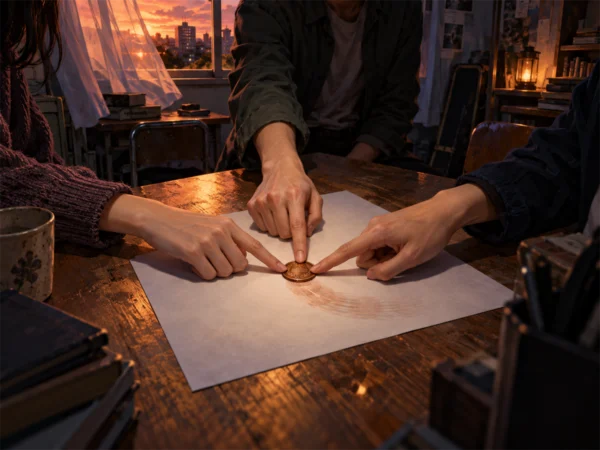
What is Kokkuri-san?
Kokkuri-san is a form of divination in which a 10-yen coin is placed on a sheet of paper marked with “yes,” “no,” the Japanese syllabary and numbers. Several people rest a finger on the coin and call out, “Kokkuri-san, Kokkuri-san, please come.” When they ask a question, the coin is said to move by itself to show the answer. The name is written with characters meaning “fox, dog and tanuki,” and it was thought to summon the spirits of foxes and the like.
The Meiji-era craze and Inoue Enryo
Kokkuri-san is said to derive from “table turning,” the practice of communicating with spirits around a table that was popular in 19th-century Europe and America. It reached Japan in the Meiji era and became a nationwide craze in a form using a tray on a stand of bamboo. The philosopher Inoue Enryo investigated it and explained in Yokai Genkai (1887) that the movements were caused not by spirits but by the psychology and unconscious movements of the participants.
The 1970s boom and a word of caution
In the 1970s, a manga sparked a huge craze among children, and rumors that “if you stop halfway, you’ll be possessed” led some schools to ban it to prevent panic. The coin’s movement is thought to be caused by the “ideomotor effect,” in which participants unconsciously press with their fingers.