What is the singularity?
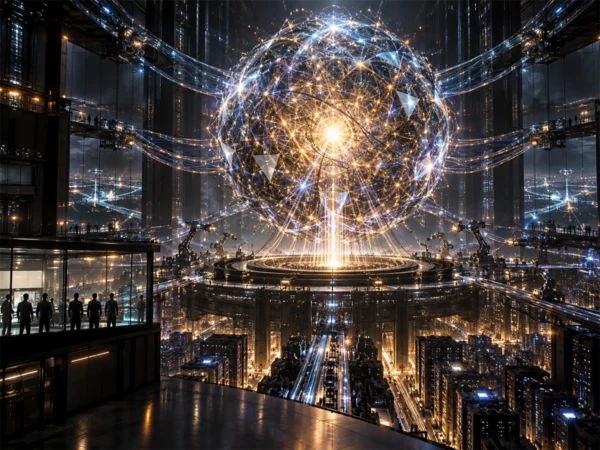
The singularity (technological singularity) is the turning point at which technologies such as artificial intelligence surpass human intelligence and keep improving themselves, so that technological progress becomes so rapid it can no longer be predicted by earlier common sense. “Singularity” was originally a term in mathematics and physics for a point where ordinary laws no longer apply.
Who proposed it, and the “2045 problem”
The idea goes back to the mathematician John von Neumann, who in the mid-20th century reportedly said that the acceleration of technology was approaching an essential singularity in human history. In 1993, the science fiction writer and mathematician Vernor Vinge spread the term in his essay “The Coming Technological Singularity,” arguing that intelligence greater than human would be created within 30 years.
Then the inventor and futurist Ray Kurzweil predicted in his 2005 book The Singularity Is Near that the singularity would arrive around 2045. From this, the time when AI surpasses human intelligence also came to be called the “2045 problem” in Japan.
The singularity as urban legend
The singularity is sometimes linked with stories like those of science fiction films: “AI will rebel and rule humanity” or “we will upload human consciousness to computers and become immortal.” The image that “one day the world will suddenly change completely” has also made it a subject of doomsday and conspiracy theories.
Among researchers, however, opinions are sharply divided on whether the singularity will really come and, if so, when. It has drawn renewed attention with the rapid development of generative AI, but actual debate centers on practical issues such as AI safety, the impact on jobs and the making of rules for society. It is often discussed alongside dystopian works depicting the nightmare of a controlled society.