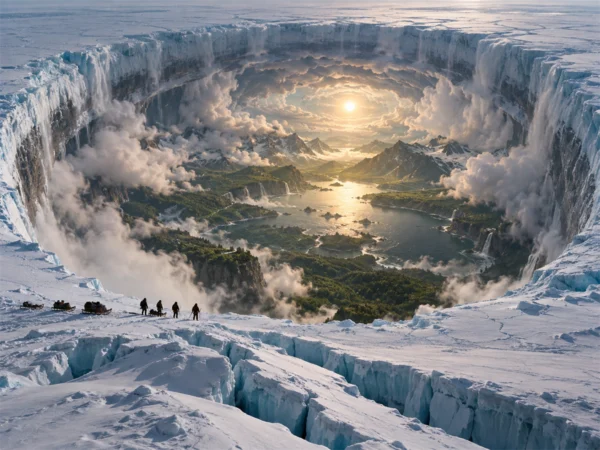
What is the hollow Earth theory?
The hollow Earth theory holds that the Earth’s interior is hollow, with another world, creatures or a civilization inside. It is said that a small sun shines at the center of the underworld, and that huge entrances to it open at the North and South Poles. Modern science rejects it, but it has long been a popular subject of science fiction and urban legends.
Halley’s hollow Earth
The first to propose the hollow Earth as a scientific hypothesis is said to be Edmond Halley, the English astronomer known for Halley’s Comet. In 1692, to explain why the direction a compass points slowly changes over the years, Halley proposed that the Earth’s interior consists of several nested shells of different sizes, each with its own magnetic poles and rotating separately. He also thought there might be air between the shells, and perhaps living things.
In the 19th century, the American John Cleves Symmes claimed there were huge holes leading underground at the North and South Poles (“Symmes holes”) and even called for an expedition. Jules Verne’s novel Journey to the Center of the Earth (1864) also captivated many readers with its adventure inside the Earth.
Urban legends of the underworld
In the 20th century, the hollow Earth theory became tied to mysticism and the occult, and stories spread that the underground kingdom of Agartha or Shambhala, with an advanced civilization, lies below, and that UFOs fly from the underworld. There is also the tale of a “secret diary” in which the American explorer Admiral Byrd strayed into the underworld while flying over the North Pole, but it is thought to have been fabricated later.
Images claiming that “a hole at the North Pole shows up in satellite photos” also go viral online, but these are explained as polar areas left black where no data was captured when many photos were combined.
What is the inside of the Earth really like?
Today, by studying how earthquake waves (seismic waves) travel through the Earth, its internal structure is known in considerable detail. From the outside in, the Earth is divided into the crust, mantle, outer core and inner core, and the inner core at the center is thought to be solid iron and nickel. Calculations from the Earth’s mass also show that a huge cavity inside is impossible.