Who is Humbaba?
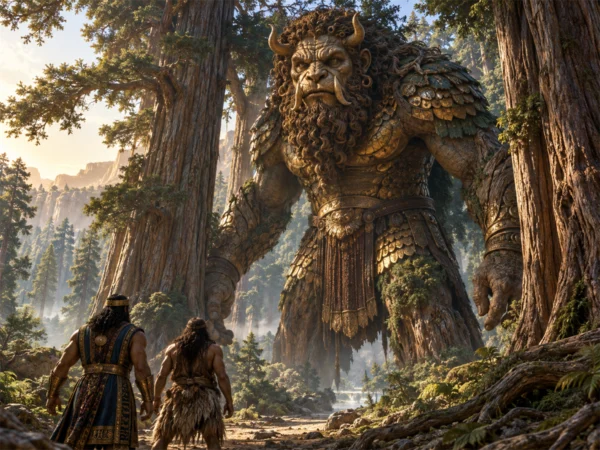
Humbaba (Huwawa in Sumerian) is a monster in the Epic of Gilgamesh, one of the oldest stories in the world. He was the guardian entrusted by Enlil, king of the gods, with protecting the “Cedar Forest” far to the west. His roar is described as a flood, his mouth as fire and his breath as death.
Humbaba’s face is often shown with a pattern like coiled entrails, and in ancient Mesopotamia it was linked with divination using sheep’s entrails. Clay masks in the shape of Humbaba’s face have also been found, used to ward off evil.
The battle with Gilgamesh and Enkidu
Seeking fame, Gilgamesh, king of Uruk, overrode the objections of his friend Enkidu and set out for the Cedar Forest, determined to defeat Humbaba. Humbaba wore seven terrifying radiant auras called “melammu,” but he was pinned down by strong winds sent by the sun god Shamash.
Cornered, Humbaba begged for his life, but at Enkidu’s urging Gilgamesh cut off his head, felled the forest’s cedars and carried them back to his city. But killing the guardian appointed by the gods angered them, and it is said to have been one reason for Enkidu’s later death.
Where was the Cedar Forest?
The Cedar Forest of the story is thought to be modeled on the forests of cedar of Lebanon that covered the mountains of today’s Lebanon and Syria. For the people of Mesopotamia, who had little timber, cedar was a precious resource for building temples and palaces. The story of Humbaba may hold memories of adventures to obtain timber from forests in distant mountains.