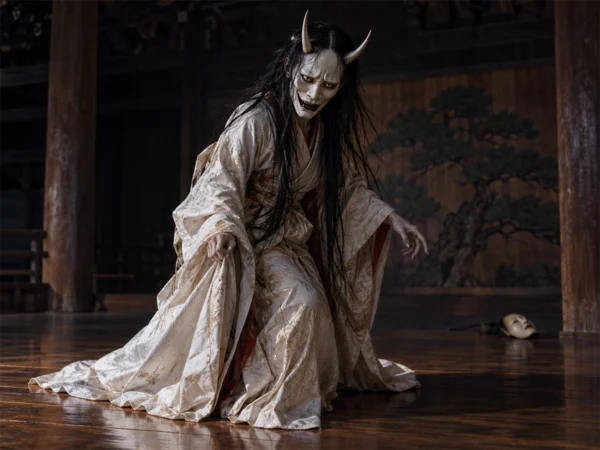
Nine-Tailed Fox (Kyubi no Kitsune)

九尾の狐

Yokai

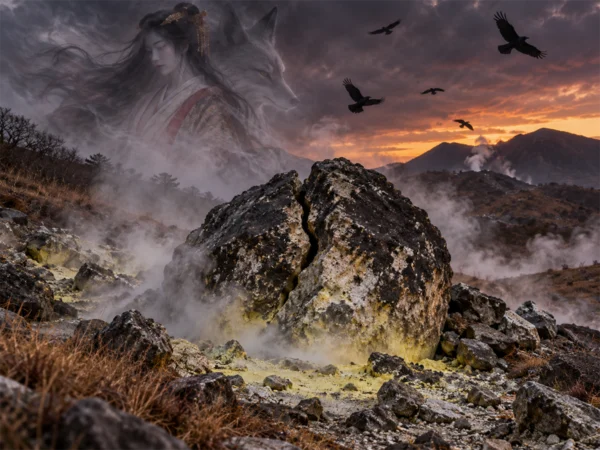
A fox yokai with nine tails. Legend says it took the form of the beautiful Tamamo-no-Mae to win over the retired Emperor Toba, was unmasked and killed on the plain of Nasu, and turned into the "Killing Stone". The stone split in 2022.

Also known asKyubi, Kyuubi, Tamamo-no-Mae, Hakumen Konmo Kyubi no Kitsune, Nine-tailed fox
Era / first recordedAncient China to the Heian period
OriginJapan
Related people
Stats
Rarity
Danger
Reality
Fame

Originally written in Japanese. 日本語版を読む (the Japanese page also has rankings and comments).

What is the nine-tailed fox?

The nine-tailed fox is a fox yokai with nine tails. It appears in the ancient Chinese geography Classic of Mountains and Seas, and in China it was sometimes even considered an auspicious sign. Later, however, it came to be described as an evil yokai that takes the form of a beautiful woman and brings ruin to nations. One legend says it bewitched kings in India and China before crossing over to Japan.

Tamamo-no-Mae and the Killing Stone

In Japan, the best-known legend says that Tamamo-no-Mae, a woman of extraordinary beauty who served the retired Emperor Toba at the end of the Heian period, was really a nine-tailed fox. When the emperor fell ill with a mysterious disease, an onmyoji diviner exposed Tamamo-no-Mae’s true identity. The fox fled to the plain of Nasu (Tochigi Prefecture) but was killed there, and its grudge is said to have become the Sessho-seki (Killing Stone), a rock that gives off poison.

The Killing Stone splits

The Sessho-seki still stands in Nasu, Tochigi Prefecture, in an area where volcanic gas seeps from the ground, and the poet Matsuo Basho visited it on his journey recorded in The Narrow Road to the Deep North. In March 2022 the stone was found split in two, setting off a wave of posts on social media asking whether the nine-tailed fox had been revived.

Nine-Tailed Fox (Kyubi no Kitsune): Legend & Sighting Locations

Please note Trespassing on private property or restricted areas is prohibited by law. Please be considerate of local residents.

Positions on the map are a rough guide to the area where a legend or sighting is set. Most pins are placed at representative points of a municipality or prefecture (outside Japan, a city position rounded to about 10 km, or the country), not at the exact place.
Municipality points: Geolonia address data (CC BY 4.0), based on the Address Base Registry (Digital Agency of Japan) / Country points: Natural Earth

Sources & References

  1. 山海経 (古代中国)
  2. おくのほそ道 (松尾芭蕉, 1702)

Please note The contents of this site introduce legends, eyewitness accounts and theories; they do not guarantee that anything described is true. The stats are our own rough guide. Trespassing on private property or restricted areas is prohibited by law. Please be considerate of local residents.

Related Entries