Who was Emperor Sutoku?
Emperor Sutoku (Sutoku-in) was the 75th emperor of Japan, of the late Heian period. Born the first son of Emperor Toba, he took the throne at just five years old, but his father, the retired Emperor Toba, disliked him and forced him to give up the throne at 23 to his younger brother, Emperor Konoe. Later collections of tales say that Sutoku was really the son of his great-grandfather, the cloistered Emperor Shirakawa, and that Toba therefore despised him, calling him his “uncle-son.”
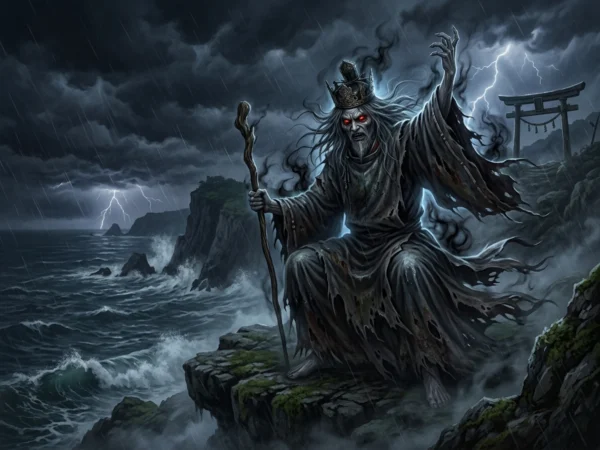
Emperor Sutoku is counted with Sugawara no Michizane and Taira no Masakado as one of the “Three Great Onryo of Japan,” and is sometimes said to be the most terrifying of them.
The Hogen Rebellion and exile to Sanuki
In 1156, after the death of the retired Emperor Toba, the retired Emperor Sutoku raised an army in a conflict with his younger brother, Emperor Go-Shirakawa: the Hogen Rebellion. But Sutoku’s side was defeated by Go-Shirakawa’s army, which had won over Taira no Kiyomori and Minamoto no Yoshitomo, and Sutoku was exiled to Sanuki Province (today’s Kagawa Prefecture). It was the first time in about 400 years that an emperor or retired emperor had been sent into exile.
The vow written in blood: “a great demon of Japan”
According to the war tale Hogen Monogatari, Sutoku became a devout Buddhist in Sanuki and spent three years copying five Mahayana sutras as a memorial to the war dead and a sign of repentance, sending them to the court with a request that they be placed in a temple in Kyoto. But Go-Shirakawa’s side suspected a curse was hidden in them, refused them and sent them back.
Enraged, Sutoku bit off his tongue and wrote on the sutras in his own blood: “I will become a great demon of Japan; I will make the emperor a commoner and the commoners emperors,” then sank them in the sea. Afterward he let his hair and nails grow wild and turned into a tengu while still alive, it is said. In 1164 he died in Sanuki at the age of 46 and was buried at Shiramine.
The curse of Sutoku-in
More than a decade after his death, Go-Shirakawa’s close relatives died one after another, and ill omens followed in Kyoto: a great fire (the Angen Fire), armed protests by the warrior monks of Enryakuji, and plots to overthrow the Taira. People feared it was the work of Sutoku’s vengeful spirit, and in 1177 the court gave him the name “Sutoku-in” in place of “Sanuki-in” to calm his spirit.
When the samurai later seized power and began to run the government in place of the emperor and the nobles, people said Sutoku’s curse, “to make the emperor a commoner and the commoners emperors,” had come true. A tengu named Sagamibo is also said to live at Shiramine in Sanuki, guarding his spirit.
“Shiramine” in Ugetsu Monogatari and Shiramine Jingu
In “Shiramine,” the first story of Ugetsu Monogatari (Tales of Moonlight and Rain) by the Edo-period writer Ueda Akinari, the poet Saigyo visits Sutoku’s grave at Shiramine and debates with his spirit, which appears like a demon king, a scene that fixed the image of Sutoku as a vengeful spirit.
In 1868, at the Meiji Restoration, Emperor Meiji sent an envoy to Sanuki before his enthronement to bring Sutoku’s spirit back to Kyoto, founding Shiramine Jingu shrine. For 700 years, Sutoku’s spirit remained one the imperial family had to console. Today his mausoleum (Shiramine Misasagi) and Shiramineji Temple are in Sakaide, Kagawa Prefecture, and Shiramine Jingu in Kyoto is also worshipped as a god of improvement in sports.
Sutoku the poet
Sutoku was also a gifted poet, and one of his love poems was chosen for the Ogura Hyakunin Isshu anthology. It compares a rushing stream split in two by a rock that later joins again to his wish to be united with his beloved someday, and it inspired the rakugo story “Sutoku-in.” It shows a passionate poet, in contrast to his image as a terrifying vengeful spirit.