Tengu

天狗

Yokai

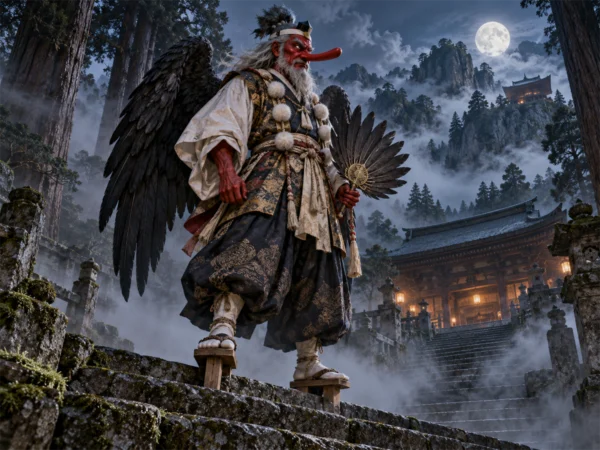
One of Japan's best-known yokai: a red-faced, long-nosed figure dressed as a mountain ascetic who flies through the sky. Tied to mountain gods and the Shugendo faith, it is linked with sacred mountains across Japan.

Also known asHanadaka-tengu, Karasu-tengu, Daitengu, Long-nosed goblin
Era / first recorded7th century (first recorded in the Nihon Shoki)
OriginJapan
Related people
Stats
Rarity
Danger
Reality
Fame

Originally written in Japanese. 日本語版を読む (the Japanese page also has rankings and comments).

Originally a “shooting star”

In ancient China, the word tengu (“heavenly dog”) was used to describe shooting stars and comets, imagined as dogs racing across the sky. In Japan, the Nihon Shoki records that in 637 a monk called a loudly roaring shooting star a tengu. This is considered the oldest record of the word in Japan.

Becoming a mountain yokai

From the medieval period on, the tengu came to be described as a yokai living in the mountains, and its familiar image took shape: dressed like a yamabushi mountain ascetic, holding a feathered fan and flying through the air. Two types are especially well known: the red-faced, long-nosed hanadaka-tengu (great tengu) and the beaked karasu-tengu (crow tengu).

Faith and legend

A famous legend tells how the tengu of Mount Kurama in Kyoto taught swordsmanship to the young Ushiwakamaru, later the warrior Minamoto no Yoshitsune. On Mount Takao and other sacred mountains, tengu are worshipped as messengers of the mountain gods. Stories of tengu carrying people off into the mountains, known as “tengu-kakushi” or spirit abduction, are also told in many regions.
Tengu: Legend & Sighting Locations

Please note Trespassing on private property or restricted areas is prohibited by law. Please be considerate of local residents.

Positions on the map are a rough guide to the area where a legend or sighting is set. Most pins are placed at representative points of a municipality or prefecture (outside Japan, a city position rounded to about 10 km, or the country), not at the exact place.
Municipality points: Geolonia address data (CC BY 4.0), based on the Address Base Registry (Digital Agency of Japan) / Country points: Natural Earth

Sources & References

  1. 日本書紀 (720)

Please note The contents of this site introduce legends, eyewitness accounts and theories; they do not guarantee that anything described is true. The stats are our own rough guide. Trespassing on private property or restricted areas is prohibited by law. Please be considerate of local residents.

Related Entries