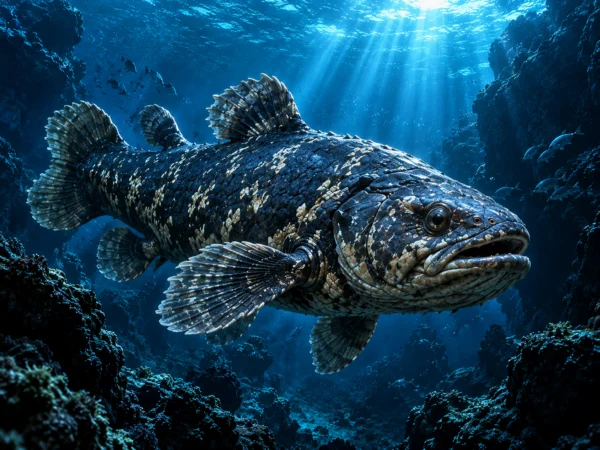
Was the coelacanth supposed to be extinct?
Coelacanths are an ancient group of fish known from fossils going back about 400 million years, and were thought to have gone extinct at the end of the Cretaceous period (about 66 million years ago), along with the dinosaurs. Finding a living coelacanth was therefore almost as astonishing as finding a living dinosaur.
How it was discovered and confirmed
In December 1938, a fishing boat off East London, South Africa, landed an unfamiliar blue fish. Marjorie Courtenay-Latimer, a curator at the local museum, noticed it and informed the ichthyologist J. L. B. Smith. Smith recognized it as a coelacanth, previously known only from fossils, and in 1939 named it Latimeria chalumnae. A second specimen was found in the Comoro Islands in the Indian Ocean in 1952, and another species was discovered in Indonesia in the late 1990s.
What we know today
Coelacanths live on rocky reefs in deep water at about 100–500 meters and have fleshy fins that move like limbs. Research continues on them as important animals for understanding the evolution from fish to land animals. Having survived long ages with almost no change in form, they are the classic example of a “living fossil.”