What is a lich?
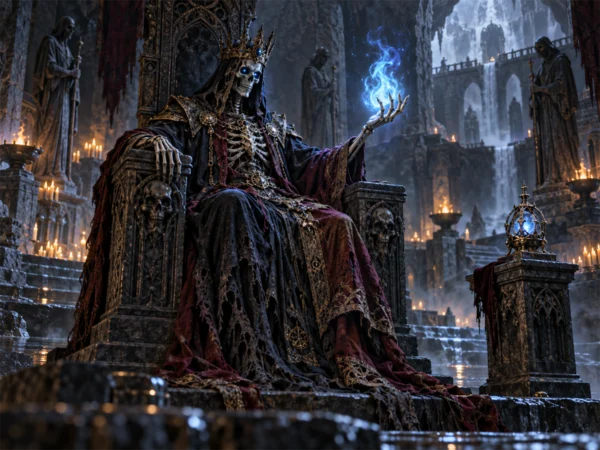
A lich is what remains of a wizard or king who used powerful magic to transform himself into an undying being. It is said to look like a skeleton or mummy and to keep the great magical power it had in life. In games and fantasy novels it often appears as a powerful boss, ranked highest among the “undead” such as zombies and skeletons.
Origin of the name
“Lich” comes from an old English word meaning “corpse.” In older English it was used in words connected with the dead, such as “lich road” for a path along which corpses were carried. In 20th-century fantasy fiction the word came to mean an undying sorcerer, and especially in tabletop role-playing games from the 1970s on it became established as a sorcerer who gained immortality by moving his soul into another vessel.
The undying sorcerer who hides his soul
A lich is said to hide its soul in a vessel called a “phylactery,” so that even if its body is destroyed, it returns again and again unless the vessel is broken. This idea closely resembles the Russian folktale of “Koschei the Deathless,” an evil king who hid his death (his soul) in a needle inside an egg and could not die unless it was broken. Along with the vampire, it is one of the leading undead of the West.