What is the Mystery Stone?
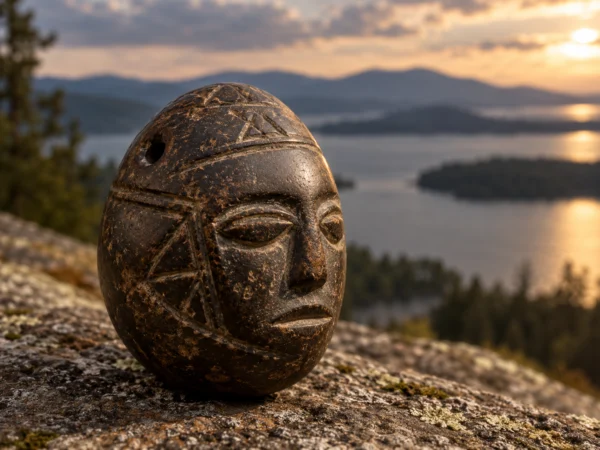
The Lake Winnipesaukee Mystery Stone was found in 1872 by a worker digging a hole for a fence post on the shore of Lake Winnipesaukee in New Hampshire, in the northeastern United States. It is a dark, egg-shaped stone about 10 cm long, polished smooth. It is now owned by the New Hampshire Historical Society and is sometimes exhibited in its museum.
Strange carvings
Its surface is carved with a variety of designs: a human face, an ear of corn, a tent-like shape, arrowheads, circles and spirals, and a moon-like figure. Holes are also drilled from both ends that meet inside. The holes differ in diameter at each end, and it is not clear how they were made with the tools of the time.
Who made it?
From the time of its discovery, many theories have been proposed: that Native Americans made it to commemorate a treaty or similar event, or that it belongs to an older culture from before the arrival of Europeans. But no similar stone has been found, and its designs have been said to differ from traditional Native American art.
Some think it is a 19th-century prank or souvenir, and the mystery remains unsolved. More than 150 years after its discovery, it is still, true to its name, a “mystery stone.” Famous OOPArts are listed on the OOPArts page.