What is the oboroguruma?
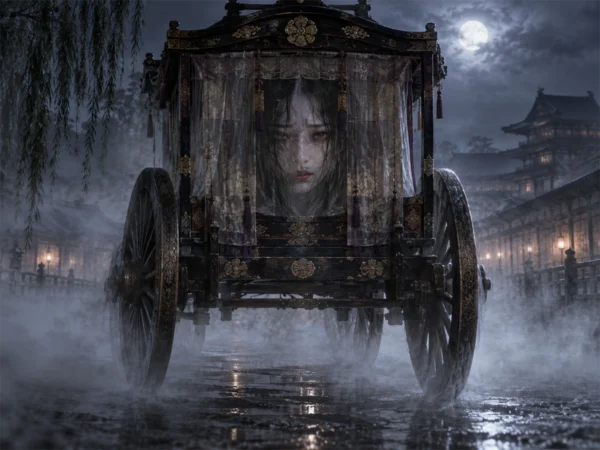
The oboroguruma is an ox-cart yokai said to appear on Kamo Avenue in Kyoto on spring nights when the moon is hazy (oboro). It is depicted with a large woman’s face emerging from the bamboo blind at the front of the carriage. It appears in Toriyama Sekien’s Edo-period yokai books.
The grudge of the carriage quarrel
Sekien explained the oboroguruma as the grudge from an old “carriage quarrel” taking shape. Carriage quarrels were disputes in which nobles’ ox-carts competed for viewing spots at festivals. The most famous is a scene from The Tale of Genji: Lady Rokujo’s carriage, out to watch the Kamo Festival, is pushed aside by the party of Aoi, Prince Genji’s wife, and she is terribly humiliated. This humiliation later leads to the tragedy in which Lady Rokujo’s living spirit possesses Aoi.
What the oboroguruma represents
The oboroguruma is thought to be the strong grudge of someone hurt in a fight over rank and face, lodged in an object, an ox-cart. It also echoes the tsukumogami, objects that gain spirits.