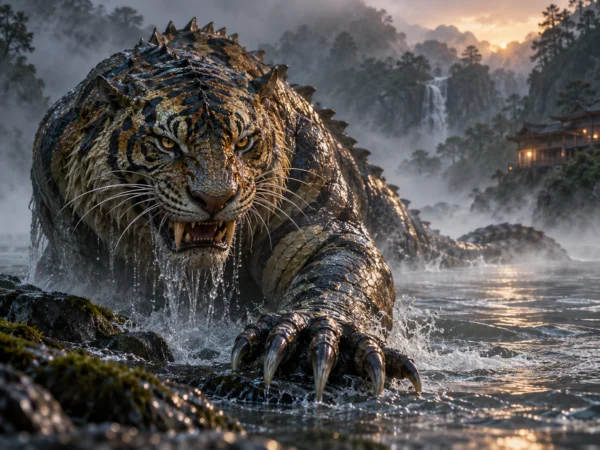
What is the suiko?
The suiko is a water yokai said to live in Chinese rivers. The Ming-dynasty pharmacological work Compendium of Materia Medica, drawing on older records, says the suiko lives in rivers in Hubei, is the size of a three- or four-year-old child, and is covered all over in scales too hard for arrows to pierce. In autumn it is said to expose itself on the sand as if sunning its shell.
Link with the kappa
In Edo-period Japan, scholars began using the name suiko as a general term for river yokai like the kappa. However, the encyclopedia Wakan Sansai Zue (1712) by Terajima Ryoan gives “suiko” and “kawataro (kappa)” separate entries, distinguishing them as different creatures. In 1820, a book called Suiko Koryaku, a kind of illustrated kappa encyclopedia collecting kappa forms and sightings from around Japan, was also compiled.
“Suiko-sama,” a god against drowning
In the Tsugaru region of Aomori Prefecture and elsewhere, there are known examples of the suiko being called “Suiko-sama” and worshipped as a god protecting children from water accidents. A fearsome water yokai was instead revered as a guardian against drowning.
Water yokai of Japan
Besides the kappa, Japan has many yokai said to live in rivers and marshes, such as the hyosube of Kyushu, considered a relative of the kappa. Such stories are also thought to have served to warn children of the dangers of playing by the water.