Yuki-onna (Snow Woman)

雪女

Yokai

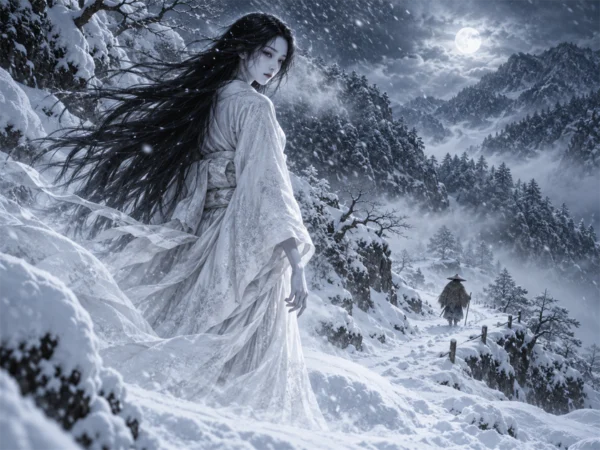
A beautiful female yokai in a white kimono who appears on snowy nights and freezes people with her icy breath. The version in Lafcadio Hearn's Kwaidan is the most famous, and legends of her are told throughout Japan's snow country.

Also known asYuki-onna, Yuki-jōrō, Yuki-musume, Snow woman, Snow maiden
Era / first recordedMuromachi period onward
OriginJapan
Related people
Stats
Rarity
Danger
Reality
Fame

Originally written in Japanese. 日本語版を読む (the Japanese page also has rankings and comments).

What is yuki-onna?

Yuki-onna is a yokai said to appear on snowy nights or in blizzards as a beautiful woman in a white kimono. With skin so pale it seems transparent, she freezes people to death with her cold breath or leads them astray in the snow. Legends of her are told in many places, especially in the snowy Tohoku and Hokuriku regions.

Lafcadio Hearn’s “Yuki-Onna”

The best-known yuki-onna story is “Yuki-Onna” in Kwaidan (1904) by Lafcadio Hearn (Koizumi Yakumo). On a night of fierce snow, a young man named Minokichi meets a snow woman in a mountain hut. She spares him, warning that he will die if he ever tells anyone about that night. Later Minokichi marries a beautiful young woman named O-Yuki and they have children, but one night he lets slip the story. O-Yuki reveals that she herself was the snow woman; for the sake of their children she does not take his life, and she vanishes as a white mist.

Yuki-onna in folklore

Yuki-onna legends vary from region to region. In some she asks travelers to hold her baby; in others she melts away when put in a hot bath. The stories convey the harshness of winter and the terror of blizzards, and are also told as tales of marriage between a human and an otherworldly being. She was painted by Toriyama Sekien in his illustrated yokai books.

Yuki-onna (Snow Woman): Legend & Sighting Locations

Please note Trespassing on private property or restricted areas is prohibited by law. Please be considerate of local residents.

Positions on the map are a rough guide to the area where a legend or sighting is set. Most pins are placed at representative points of a municipality or prefecture (outside Japan, a city position rounded to about 10 km, or the country), not at the exact place.
Municipality points: Geolonia address data (CC BY 4.0), based on the Address Base Registry (Digital Agency of Japan) / Country points: Natural Earth

Sources & References

  1. 怪談(KWAIDAN) (小泉八雲, 1904)

Please note The contents of this site introduce legends, eyewitness accounts and theories; they do not guarantee that anything described is true. The stats are our own rough guide. Trespassing on private property or restricted areas is prohibited by law. Please be considerate of local residents.

Related Entries