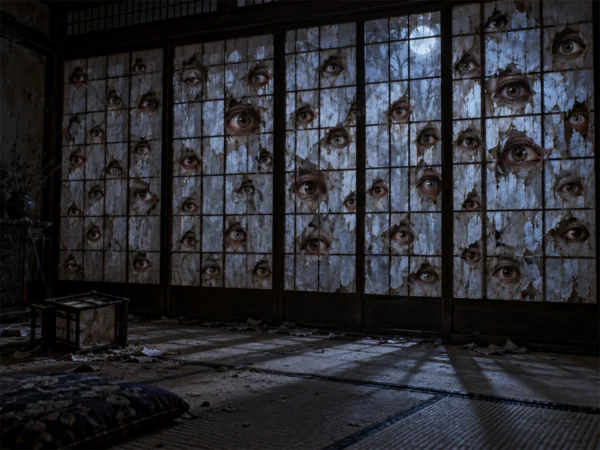
What is Mokumokuren?
Mokumokuren is a yokai in which countless eyes appear, one in each square of the paper sliding screens (shoji) of a ruined old house. The Edo-period artist Toriyama Sekien depicted it in his 1781 yokai picture book Konjaku Hyakki Shūi. The image of dozens of eyes staring out at once from the squares of the screens is known as one of the eeriest of all yokai pictures.
A yokai born from a go player’s obsession
In the text accompanying his picture, Sekien says Mokumokuren appeared in a house where a go player (a master of the board game go) had lived, and explains it as the player’s intense focus on the go board spreading throughout the house. Both a go board and a shoji screen are divided into a grid of squares, called “me” (eyes) in Japanese. It is a yokai built on wordplay: the obsession of staring at the “eyes” of the go board passing into the “eyes” of the house’s screens.
Some folklore researchers think Mokumokuren is not an old tradition but a yokai Sekien invented. Others suggest its name plays on Ichimokuren, the name of a one-eyed god.
Mokumokuren in later stories
As Sekien’s picture became known, stories of countless eyes appearing on screens or in rooms came to be told as Mokumokuren. The manga artist Mizuki Shigeru introduced related tales, such as a story of a samurai of the Nanbu domain whose room filled with eyeballs that kept multiplying.
There is also a story from Mizuki’s own family. His second daughter, staying at an inn in Kyoto on a school trip, saw something like eyes moving on the shoji one night, and Mizuki is said to have told her, “That was Mokumokuren.” The scene was depicted in the 2010 NHK morning drama Gegege no Nyōbō.
Are the eyes an illusion?
Eyes seen on shoji may be explained by an optical illusion. When you stare at a white grid pattern, dark dots that are not really there can seem to flicker where the lines cross, an effect known as the Hermann grid illusion. In a TV experiment, people who looked at a grid pattern like a shoji screen said they saw something like eyes. An old shoji lit by moonlight at night may have seemed to fill with countless eyes, giving rise to the Mokumokuren story.
“Walls have ears, shoji have eyes”
Japan has a proverb: “Walls have ears, and shoji have eyes.” It warns that someone may be listening behind a wall or peeping from behind a paper screen, so you never know where a secret may leak. Shoji, which divide rooms with a single sheet of paper, easily let light and sound through, and in old Japanese houses whatever went on outside a room was quickly sensed inside. The scene of someone poking a hole in a shoji with a finger to peep through is a familiar one in period dramas. Mokumokuren could be called this proverb turned into a yokai.
The fear of being watched
The fear of feeling watched in a place where no one should be is common to many ghost stories. Other yokai drawn by Sekien include Dorotabō, who cries “Give back my field,” and Wanyūdō, the flaming wheel. Mokumokuren also connects to the idea of tsukumogami, in which old objects and houses gain a spirit.