We list 10 places in Tokyo where yokai, cryptids and legends are told or sighted, and 9 related encyclopedia entries.
Please note
Trespassing on private property or restricted areas is prohibited by law. Please be considerate of local residents.
Positions on the map are a rough guide to the area where a legend or sighting is set. Most pins are placed at representative points of a municipality or prefecture (outside Japan, a city position rounded to about 10 km, or the country), not at the exact place. Municipality points: Geolonia address data (CC BY 4.0), based on the Address Base Registry (Digital Agency of Japan) / Country points: Natural Earth
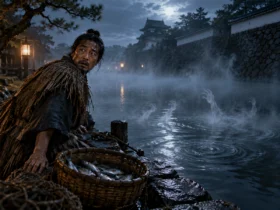
One of the "Seven Wonders of Honjo," ghost stories of Honjo in Edo (today's Sumida, Tokyo). When anglers tried to take home fish caught in the moat, a voice from the water said "Leave it, leave it," and the fish vanished. It is said to be the origin of the Japanese expression "oitekebori" (being left behind).
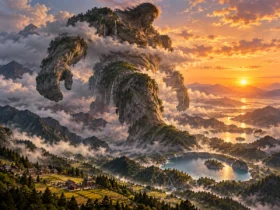
Legends of a giant said to have made mountains and lakes, told all over Japan. He is said to have made Mount Fuji or dug Lake Biwa, and hollows and ponds said to be his footprints remain in many places. He is also said to be the origin of the place name Daita in Tokyo.
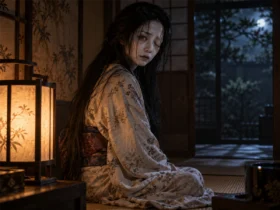
Japan's most famous ghost story, told in the Edo-period kabuki play Tokaido Yotsuya Kaidan. Betrayed by her husband Iemon and poisoned so that her face is disfigured, Oiwa returns as a vengeful ghost. It is said that a curse falls on productions whose members do not first visit the shrine dedicated to Oiwa.
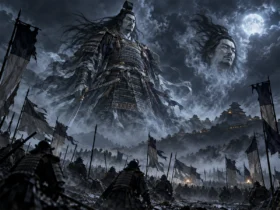
The legend of the vengeful spirit of Taira no Masakado, who rebelled in the Kanto region in the Heian period and was killed. His head, displayed in Kyoto, is said to have flown east in search of its body, and the Masakado head mound in Otemachi, Tokyo, is still carefully tended.
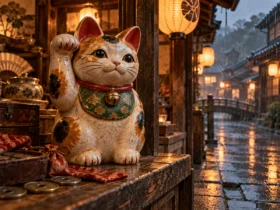
A cat figurine with one paw raised, beckoning customers and good fortune. A raised right paw is said to invite money, a raised left paw customers. Its origin is told in several stories, such as Ii Naotaka at Gotokuji Temple in Tokyo, and the lucky charm has spread worldwide.
A water yokai said to live in rivers and ponds, with a dish of water on top of its head. Alongside frightening tales, it is known for friendlier ones, such as its love of sumo wrestling and cucumbers.
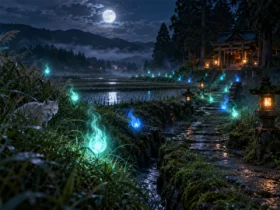
Ghostly balls of light that appear in rows, flickering across the fields and mountains at night. They were said to be lit by foxes and to be the lanterns of a fox wedding procession. At Oji Inari in Edo, foxes from all over the Kanto region were said to gather on New Year's Eve and light fox fires.
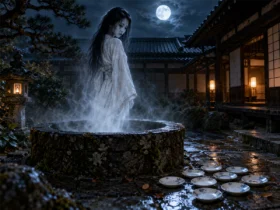
A ghost story set in Bancho, Edo. Okiku, a maid in a samurai mansion, was killed for breaking a treasured plate and thrown into a well, and from then on a voice counting plates was heard from the well every night. It is one of Japan's most famous ghost stories.
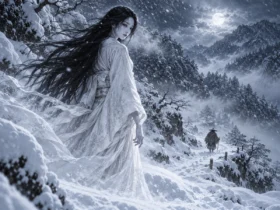
A beautiful female yokai in a white kimono who appears on snowy nights and freezes people with her icy breath. The version in Lafcadio Hearn's Kwaidan is the most famous, and legends of her are told throughout Japan's snow country.