Satori
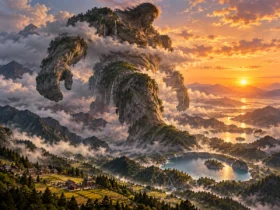
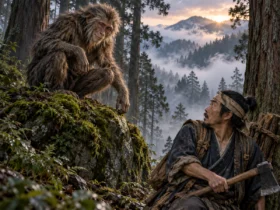
A mountain yokai that reads people's minds. It frightens people by guessing their thoughts one after another, but it is helpless against the unexpected. Told of in the mountains of Hida and Mino, it was also drawn by Toriyama Sekien.
Japanese yokai, cryptids, urban legends, UFOs, mythical beasts and ancient mysteries, translated into English.
Entries: 431
A mountain yokai that reads people's minds. It frightens people by guessing their thoughts one after another, but it is helpless against the unexpected. Told of in the mountains of Hida and Mino, it was also drawn by Toriyama Sekien.
A person who posted on internet message boards from 2000 claiming to be a time traveler from 2036. His predictions of a civil war and a world war did not come true, but he is still told of as the classic "man from the future."
A triangular area of ocean connecting the Florida Peninsula, Bermuda and Puerto Rico. It became famous as a "sea of mystery" where ships and planes vanish, but accidents there are not considered especially frequent.
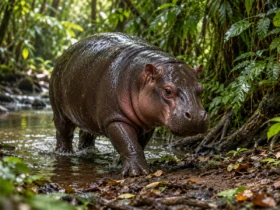
A small hippopotamus of the forests of West Africa. Its skull was known in the 19th century, but its living form was a mystery and it was considered a "phantom animal" until one was captured in the early 20th century. It is one of the world's three great rare animals, with the okapi and giant panda.
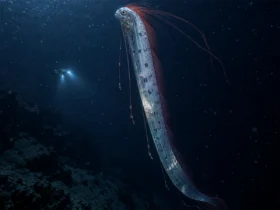
A long, slender silver deep-sea fish over 3 meters long. It is thought to be behind sea serpent and mermaid legends, and is known in Japan for the folk belief that it heralds earthquakes. Research has found no link to earthquakes.
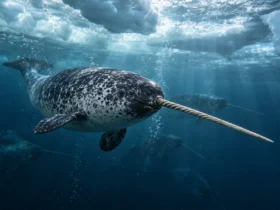
A whale of the Arctic seas with a single long tusk. In medieval Europe its tusks were traded at high prices as the horns of the legendary unicorn. It is the real "unicorn of the sea."
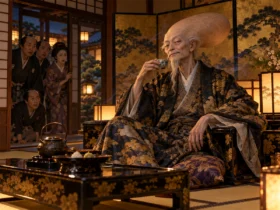
A yokai in the form of an old man with a large, protruding back of the head. It slips into houses during the busy evening hours and relaxes, drinking tea as if it were the master. Its image as the "supreme commander of the yokai" spread only in modern times.
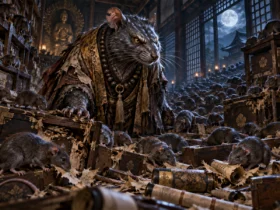
A yokai born when the grudge of the Heian-period monk Raigo turned into a horde of rats with iron teeth. They are said to have devoured the scriptures and Buddhist statues of Enryakuji Temple on Mount Hiei. Toriyama Sekien also drew it in his yokai books.
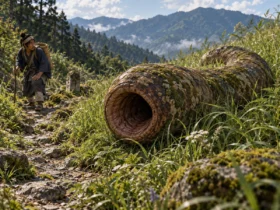
A yokai said to live in the mountains and fields, with no eyes or nose, only a big mouth. It is said to roll down slopes to attack people. It is also known as one of the old names of the tsuchinoko.
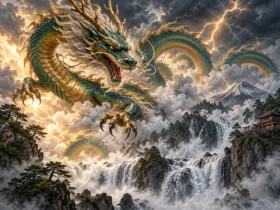
A sacred creature with a long, snake-like body, horns and scales that governs water and rain. It came to Japan from China, where belief in the dragon god Ryujin, master of lakes, rivers and ponds, took deep root.
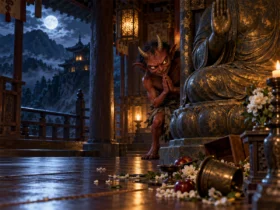
A little demon that reads people's hearts and deliberately does the opposite to make mischief. It is linked with the imps trampled underfoot by guardian statues, and its name became the word for a contrary person.
Legends of a giant said to have made mountains and lakes, told all over Japan. He is said to have made Mount Fuji or dug Lake Biwa, and hollows and ponds said to be his footprints remain in many places. He is also said to be the origin of the place name Daita in Tokyo.
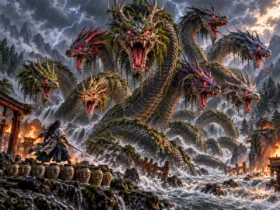
A gigantic serpent with eight heads and eight tails. Described in the Kojiki and Nihon Shoki, it was slain by the god Susanoo after being made drunk on sake, and the sword Kusanagi was found in its tail. It is the most famous monster of the Izumo myths.
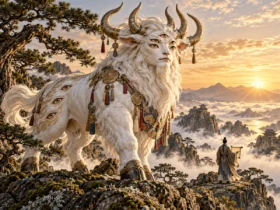
A legendary sacred beast of China that speaks human language and knows about every yokai and calamity in the world. In Edo-period Japan, pictures of it became popular as charms against illness and disaster.
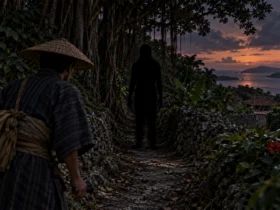
One of the most feared evil spirits (majimun) of Okinawa and Amami. It stands in the way on night roads like a black wall or pillar, growing tall enough to reach the sky, and once you meet it, there is no escape.
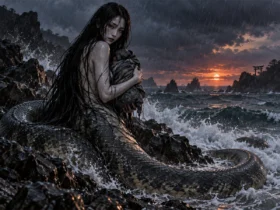
A yokai with a woman's face and a long snake's body that appears by the sea and rivers. It is called "wet woman" because its hair is always wet. It is famous for the tale in which it makes people hold a baby so they cannot move, then attacks with the ushi-oni.
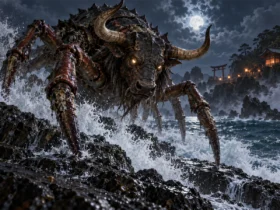
A fearsome yokai with the head of an ox and the body of an oni or a spider. It appears on coasts and in deep pools in western Japan and attacks people. It is known for the tale in which it teams up with the nure-onna, and for the Ushi-oni festival of Uwajima, Ehime Prefecture.
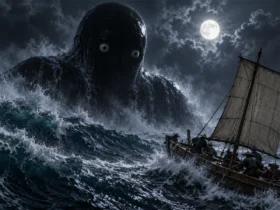
A giant, black, bald-headed yokai that suddenly appears on the sea at night. It is said to capsize ships or ask for a ladle to fill boats with water. Theories identify it as a sea turtle, a whale or a mirage.
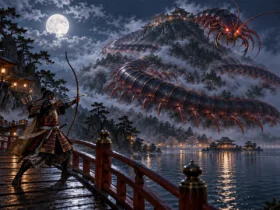
A centipede yokai so huge it could coil seven and a half times around Mount Mikami in Omi Province. It is known for the legend in which Fujiwara no Hidesato (Tawara Toda), at the request of the dragon god of Lake Biwa, shot it down with an arrow wet with his saliva.
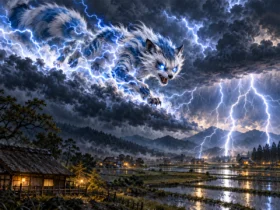
A beast yokai said to fall from the sky with lightning. It was thought to leave claw marks on trees struck by lightning. Records and pictures of raiju being caught survive from many parts of Edo-period Japan, and one theory is that they were really masked palm civets or similar animals.