Akai Chanchanko (The Red Vest)
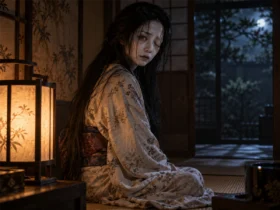
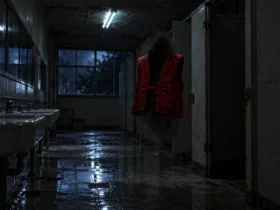
A school ghost story in which a voice in the school toilet asks, "Shall I put a red vest on you?" If you answer "yes," your throat is cut and blood runs down your back, making it look as if you are wearing a red vest.
Japanese yokai, cryptids, urban legends, UFOs, mythical beasts and ancient mysteries, translated into English.
Entries: 431
A school ghost story in which a voice in the school toilet asks, "Shall I put a red vest on you?" If you answer "yes," your throat is cut and blood runs down your back, making it look as if you are wearing a red vest.
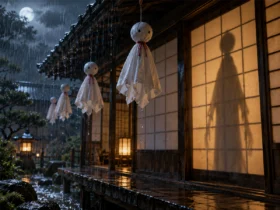
An urban legend about the doll hung from the eaves to wish for sunny weather, and the children's song about it. Because the song's third verse says the doll's head will be cut off if it doesn't clear up, frightening stories about its origin are told.
An urban legend about the 1959 children's song "Sacchan." It was rumored that the song has a "phantom fourth verse" telling how Sacchan died in an accident, and that Sacchan appears to anyone who learns of it.
An urban legend about "Green Green," a song sung in elementary school music classes in Japan. Because the later verses describe the boy's parting from his father, many dark interpretations are told: the father died in a war or accident, or it is a song about nuclear war.
A tale of a vengeful spirit set in Hanyu Village, Shimousa Province (today's Joso, Ibaraki Prefecture), in the Edo period. The spirit of Kasane, murdered by her husband, haunted two generations until the high priest Yuten Shonin laid it to rest. It is also known from the rakugo epic Shinkei Kasanegafuchi.
Japan's most famous ghost story, told in the Edo-period kabuki play Tokaido Yotsuya Kaidan. Betrayed by her husband Iemon and poisoned so that her face is disfigured, Oiwa returns as a vengeful ghost. It is said that a curse falls on productions whose members do not first visit the shrine dedicated to Oiwa.
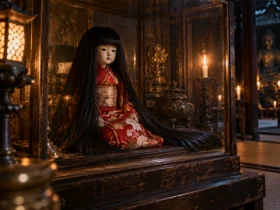
A Japanese doll kept at Mannenji Temple in Iwamizawa, Hokkaido, whose hair is said to grow. It belonged to Kikuko, a little girl who died young, and after her death the doll's bobbed hair began to grow, it is said. It is one of the most famous mysterious dolls in Japan.
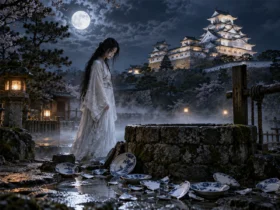
A dish-mansion ghost story set at Himeji Castle in Hyogo Prefecture. Okiku, a maid who discovered a plot against her lord, was framed when a treasured plate was hidden, and thrown into a well. "Okiku's Well" still remains at Himeji Castle, and the legend of the "Okiku bug" is also told.
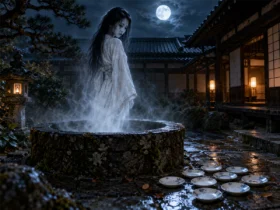
A ghost story set in Bancho, Edo. Okiku, a maid in a samurai mansion, was killed for breaking a treasured plate and thrown into a well, and from then on a voice counting plates was heard from the well every night. It is one of Japan's most famous ghost stories.
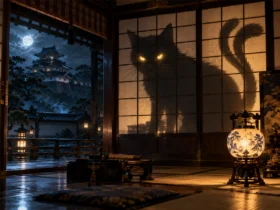
A ghost-cat story set in the Nabeshima household of the Saga domain. To avenge the mother of a retainer killed by the lord, her pet cat becomes a bakeneko and torments him. It was a huge hit in late Edo-period storytelling and kabuki, and is counted first among Japan's three great ghost-cat disturbances.
The strange feeling of strongly sensing "this has happened before" in a place you are visiting for the first time or during a new experience. It means "already seen" in French. Many people are said to experience it, and it is sometimes linked with memories of past lives or precognitive dreams.
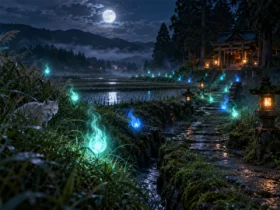
Ghostly balls of light that appear in rows, flickering across the fields and mountains at night. They were said to be lit by foxes and to be the lanterns of a fox wedding procession. At Oji Inari in Edo, foxes from all over the Kanto region were said to gather on New Year's Eve and light fox fires.
A legendary substance of alchemy believed to turn metals such as lead into gold, and even to grant immortality when drunk. Many alchemists of medieval Europe sought to make it, and a legend says the Paris scribe Nicolas Flamel succeeded.
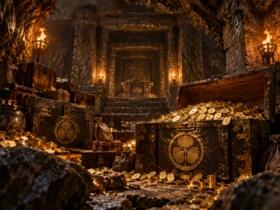
A legend that just before the fall of the Edo shogunate, its huge war chest was secretly buried somewhere. The theory that the shogunate's finance commissioner Oguri Kozukenosuke hid it on Mount Akagi in Gunma Prefecture is famous, and large TV excavations drew attention, but nothing has been found.
An urban legend about the children's song "Ichinensei ni Nattara," which expresses excitement about starting elementary school. Because counting up the song's friends leaves one person missing, dark interpretations are told, such as "one was left out by bullies" or "someone vanished."
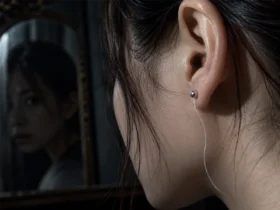
An urban legend that spread in the 1990s: a girl got her ears pierced, a white thread came out of the hole, and when she pulled it out, everything suddenly went black and she went blind, because the white thread was her optic nerve. Medically it is said to be impossible.
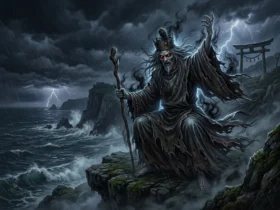
The 75th emperor of Japan, of the late Heian period. Defeated in the Hogen Rebellion, he was exiled to Sanuki (Kagawa Prefecture) and died there. He is said to have vowed to become "a great demon of Japan" and turned into a tengu while still alive, and is counted with Sugawara no Michizane and Taira no Masakado as one of the Three Great Onryo of Japan.
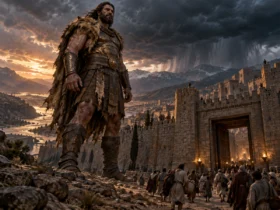
Mysterious giants in Genesis and other books of the Old Testament. They are said to be the children of the "sons of God" and human daughters, and in the Book of Enoch they are the children of fallen angels. Said to have been destroyed by Noah's Flood, they are a subject of giant legends.
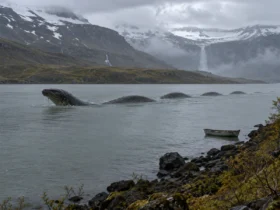
A serpent-like cryptid said to live in Lake Lagarfljot in eastern Iceland. It is recorded in 14th-century annals. In 2012, a video said to show it swimming in undulating waves across the lake was released, causing a worldwide sensation.
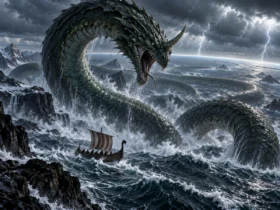
A serpent in Norse mythology so huge it encircles the world. A child of the evil god Loki and brother of Fenrir, he was thrown into the sea and grew until he surrounded the human world, biting his own tail. At Ragnarok, the final battle, he and the thunder god Thor kill each other.