Leviathan
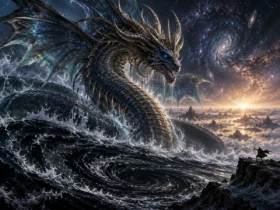
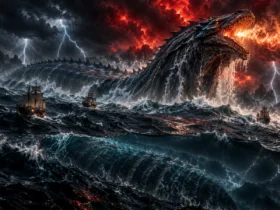
A giant sea monster in the Old Testament. Described as the mightiest creature God made, it breathes fire, and no weapon can harm it. It was later linked with demons and became the title of Hobbes's work of political philosophy.
Japanese yokai, cryptids, urban legends, UFOs, mythical beasts and ancient mysteries, translated into English.
Entries: 431
A giant sea monster in the Old Testament. Described as the mightiest creature God made, it breathes fire, and no weapon can harm it. It was later linked with demons and became the title of Hobbes's work of political philosophy.
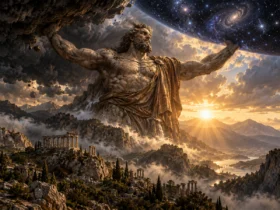
The race of giant gods who ruled the world before the Olympian gods in Greek mythology. Children of the sky god Uranus and the earth goddess Gaia, they were led by Cronus. They lost the ten-year war against Zeus and his siblings known as the Titanomachy.
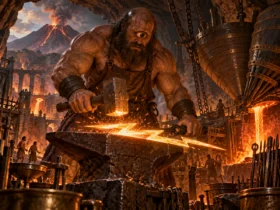
Giants in Greek mythology with a single eye in the middle of the forehead. They are told of as master smiths who made Zeus's thunderbolts, while in the Odyssey the cyclops Polyphemus is a man-eating giant who captures and eats the hero Odysseus's men.
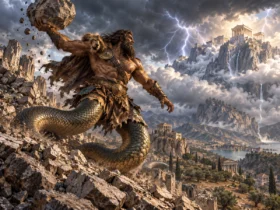
The race of giants in Greek mythology. Born from Gaia, goddess of the earth, they challenged the Olympian gods to battle (the Gigantomachy). The gods won with the help of the human hero Heracles. They are said to be the origin of the English word "giant."
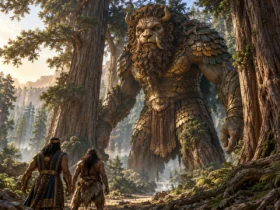
The monstrous guardian of the Cedar Forest in the Epic of Gilgamesh of ancient Mesopotamia. Ordered by the god Enlil to guard the forest, he had a terrifying face and seven radiant auras. He was slain by the hero Gilgamesh and his friend Enkidu.
In Norse mythology, the primordial giant who appeared first, before the world was born. Ancestor of the frost giants, he was killed by Odin and his two brothers, and the world, including earth, sea, sky and mountains, was made from his body.
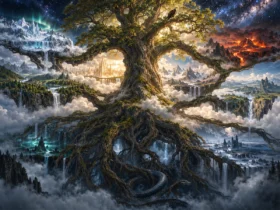
In Norse mythology, the giant ash tree, the "World Tree," that rises through the nine worlds. At its roots is a well where the goddesses of fate live, and the chief god Odin hung from it to win the secret of the runes. It witnesses the world from beginning to end.
The primordial goddess of the sea in the Babylonian creation myth Enuma Elish. She created an army of monsters and fought the young gods, but was defeated by the hero god Marduk, who split her body in two to make heaven and earth.
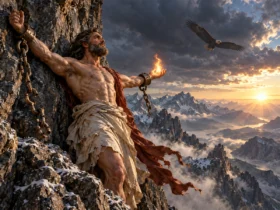
A Titan god of Greek mythology who stole the fire of the gods and gave it to humans, bringing civilization. As punishment, the angry Zeus chained him to a mountain where a great eagle pecked at his liver every day, until he was rescued by the hero Heracles.
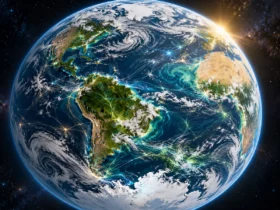
The idea that Earth's living things and its air, oceans and rocks interact so that the whole Earth regulates its environment as if it were a single living organism. It was proposed by the British scientist Lovelock in the 1970s. It is also told as a mystical theory that "the Earth is alive."
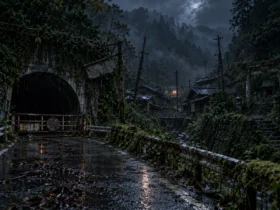
An urban legend that a village erased from the maps lies beyond Inunaki Pass in Fukuoka Prefecture, with a sign saying "Beyond here, the Japanese Constitution does not apply." In reality, a real village, Inunakidani, was relocated for the construction of a dam.
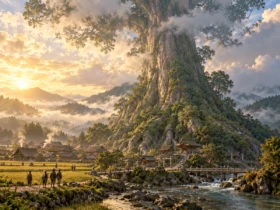
A place in Chikugo, Kyushu, recorded in the Nihon Shoki as the site of a gigantic fallen tree. The tree was 970 jo (about 3 km) long; its shadow in the morning sun covered Mount Kishima in Saga, and in the evening sun Mount Aso in Kumamoto. It is said to be the origin of the place name Miike in Omuta, Fukuoka Prefecture.
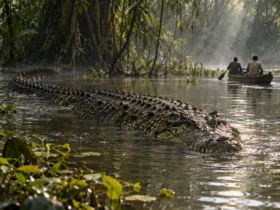
A giant crocodile cryptid up to 15 m long, said to live in the swamps and rivers of the Congo in central Africa. Told of among local people, it is said to swallow people boat and all. One theory holds that it is a surviving prehistoric giant crocodile.
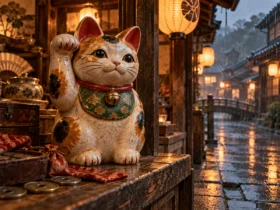
A cat figurine with one paw raised, beckoning customers and good fortune. A raised right paw is said to invite money, a raised left paw customers. Its origin is told in several stories, such as Ii Naotaka at Gotokuji Temple in Tokyo, and the lucky charm has spread worldwide.
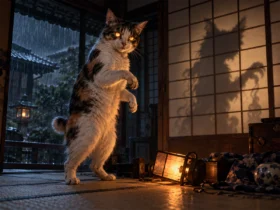
A yokai cat that has lived long enough to gain supernatural powers, taking human form or cursing people. The "Nabeshima Bakeneko Disturbance" of Saga is especially famous, and bakeneko tales were hugely popular in Edo-period kabuki and storytelling.
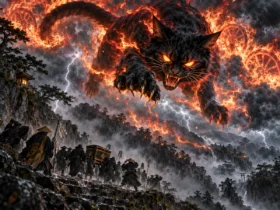
A yokai that appears at funerals and graveyards and steals the bodies of the dead. It is said to target the remains of those who did many evil deeds, and is often described as a cat yokai. Its name is said to come from the "fire cart" that carries sinners to hell.
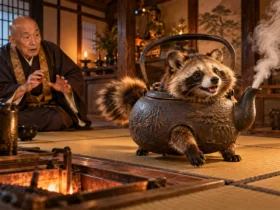
The legend of a magical tea kettle at Morinji Temple in Tatebayashi, Gunma Prefecture, that never ran out of hot water however much was drawn from it. The monk who used it turned out to be a tanuki. It later spread as the folktale of a tanuki that turned into a tea kettle and walked a tightrope.
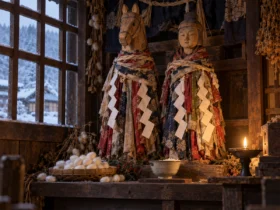
A household deity worshipped in old families of the Tohoku region: a pair of mulberry-wood figures with the faces of a horse and a girl, dressed in layers of cloth. The Legends of Tono records the tale of a tragic love between a horse and a girl from which silkworms were born.
The man-eating demon Rakshasa of Indian mythology, as it came to Japan with Buddhism. It is a fearsome demon that deceives people and eats their flesh, yet it also became Rasetsu-ten, a protector of the Buddhist law after converting to Buddhism.
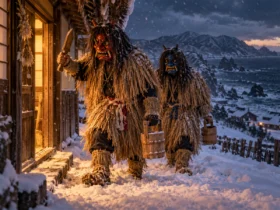
A visiting deity of a traditional New Year's Eve event on the Oga Peninsula in Akita Prefecture. Wearing demon-like masks and straw costumes called kede, Namahage go from house to house shouting "Are there any crybabies here?", scolding the lazy and bringing good fortune.