1. Heian period (legend)
    Yokai ★★★★★ Japan

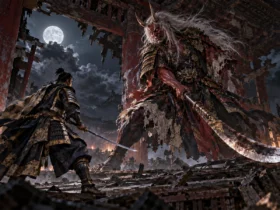
    Ibaraki-doji

    An oni said to be the chief follower of Shuten-doji, chief of the oni of Mount Oe. It is known for the legend in which Watanabe no Tsuna, one of Minamoto no Raiko's Four Heavenly Kings, cut off its arm, and it came back to retrieve it. It is a subject of Noh and kabuki.
  2. Heian period (legend)
    Yokai ★★★★★ Japan

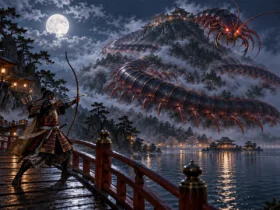
    Omukade (Giant Centipede)

    A centipede yokai so huge it could coil seven and a half times around Mount Mikami in Omi Province. It is known for the legend in which Fujiwara no Hidesato (Tawara Toda), at the request of the dragon god of Lake Biwa, shot it down with an arrow wet with his saliva.

  3. Heian period (origin of the tale)
    Yokai ★★★★★ Japan

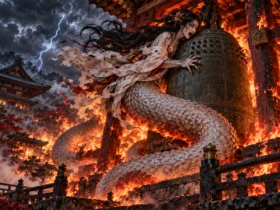
    Kiyohime

    A young woman who, betrayed in her love for the monk Anchin, turned into a giant serpent and chased him. The "Legend of Anchin and Kiyohime," in which she burned him to death inside the bell of Dojoji Temple, is a celebrated subject of Noh and kabuki.

  4. Heian period (Konjaku Monogatarishu)
    Yokai ★★★★★ Japan

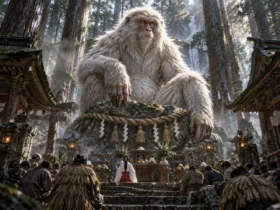
    Sarugami (Monkey God)

    A yokai in the form of an aged giant monkey living in the mountains, said to have made villagers offer girls as sacrifices. The Konjaku Monogatarishu tells of a hunter who defeated one. At the same time, monkeys have been revered as messengers of the mountain gods.

  5. Heian period (setting of the legend)
    Yokai ★★★★★ Japan

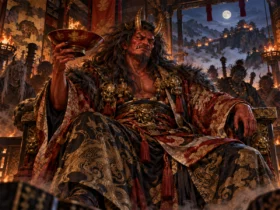
    Shuten-doji

    The leader of the oni who made Mount Oe his stronghold and abducted people from the capital. He is known from the legend in which Minamoto no Raiko and his Four Heavenly Kings, disguised as mountain ascetics, defeated him with poisoned sake.

  6. Heian period (legend)
    Yokai ★★★★★ Japan

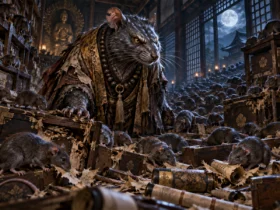
    Tesso (Iron Rat)

    A yokai born when the grudge of the Heian-period monk Raigo turned into a horde of rats with iron teeth. They are said to have devoured the scriptures and Buddhist statues of Enryakuji Temple on Mount Hiei. Toriyama Sekien also drew it in his yokai books.

  7. Heian period (The Tale of the Heike)
    Yokai ★★★★★ Japan

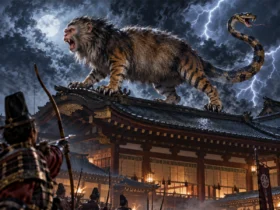
    Nue

    A monster with the face of a monkey, the body of a tanuki, the limbs of a tiger and a snake for a tail. It cried eerily at night, and in The Tale of the Heike it was shot down by Minamoto no Yorimasa. Its name became a word for anything of uncertain identity.

  8. Ancient China to the Heian period
    Yokai ★★★★★ Japan

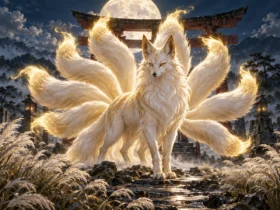
    Nine-Tailed Fox (Kyubi no Kitsune)

    A fox yokai with nine tails. Legend says it took the form of the beautiful Tamamo-no-Mae to win over the retired Emperor Toba, was unmasked and killed on the plain of Nasu, and turned into the "Killing Stone". The stone split in 2022.

  9. Recorded in the Heian period (Konjaku Monogatari) onward
    Yokai ★★★★★ Japan

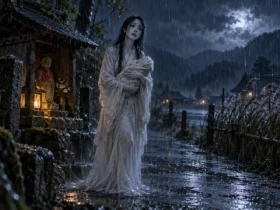
    Ubume

    A ghost or yokai of a woman who died in childbirth, appearing with a baby in her arms. She asks passers-by to hold the baby, and those who endure its growing weight to the end are said to receive great strength. A tale of her appears in the Heian-period Konjaku Monogatari, and she is linked to the "child-raising ghost" legends found across Japan.

  10. Recorded since the Heian period
    Yokai ★★★★★ Japan (Tohoku region, Nagano Prefecture, etc.)

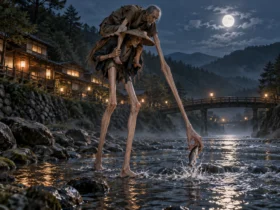
    Tenaga-ashinaga (Long-Arms and Long-Legs)

    A pair of giants: "Tenaga," with very long arms, and "Ashinaga," with very long legs. Ashinaga is said to carry Tenaga on his back to catch fish in the sea, and on Mount Chokai and Mount Bandai legends tell of them as man-eating giants who were defeated.

  11. Ancient China onward (spread in Japan in the Muromachi and Edo periods)
    Yokai ★★★★★ China

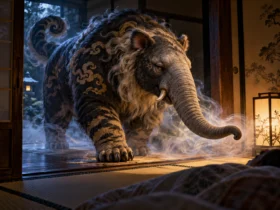
    Baku (Dream Eater)

    A sacred beast said to eat people's bad dreams. It is depicted with an elephant's trunk, a rhinoceros's eyes, an ox's tail and a tiger's legs. In China it was said to ward off evil; in Japan, the character for "baku" was written on pictures such as the treasure ship of the first dream of the year to ward off nightmares.