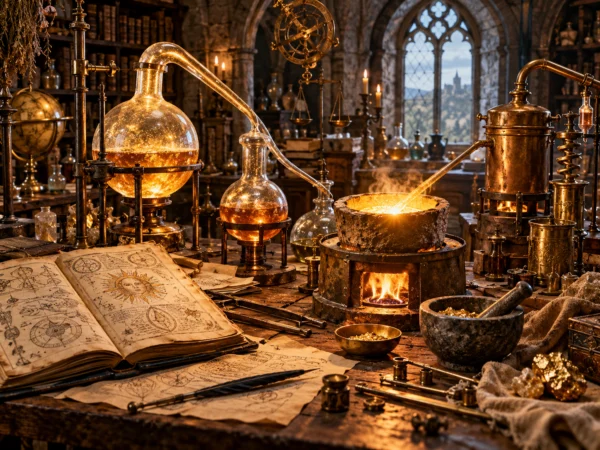
What is alchemy?
Alchemy is an art and philosophy that aimed to turn common metals such as lead into precious metals such as gold and silver. Behind it lay the goals of raising matter to perfection, and even of purifying the human soul and gaining immortality. The key was said to be the legendary philosopher’s stone.
The history of alchemy
Alchemy is said to have been born around the 3rd century AD in Alexandria, Egypt, where Greek philosophy met Egyptian metalworking. It later developed greatly in the Islamic world, and words such as “alchemy,” “alkali” and “alcohol” come from Arabic. From the 12th century, Arabic books were translated into Latin and reached Europe, and many alchemists appeared from the Middle Ages through the Renaissance.
China also had liandan, the art of making elixirs of immortality.
Famous alchemists
The 16th-century physician Paracelsus applied alchemy to making medicines and is said to have written down how to make the artificial human homunculus. The Englishman George Ripley is known for the Ripley Scroll, said to show in pictures how to make the philosopher’s stone. Isaac Newton, who discovered universal gravitation, also left a huge volume of notes on alchemy.
In the 20th century, the psychologist Carl Gustav Jung studied the symbols of alchemy as representing “the process of psychological growth.”
From alchemy to chemistry
Alchemists never succeeded in making gold, but they built up laboratory techniques such as distillation and sublimation and knowledge of the properties of many substances. From the 17th century, modern chemistry based on experiment and observation was born through Robert Boyle and others, and alchemy’s role came to an end. Incidentally, modern physics can make gold from other elements through nuclear reactions, but it is far too expensive to be practical.
The ouroboros, the serpent biting its own tail, is an important symbol of alchemy. Alchemy is also a popular theme in manga and anime.