Hyosube
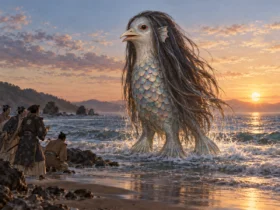
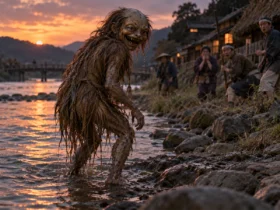
A kappa-like yokai told of in Saga Prefecture and elsewhere in Kyushu. It cries "hyo hyo," loves eggplants and ravages fields. Anyone who sees it is said to come down with a fever.
Supernatural creatures of Japanese folklore, such as the tengu and the kappa, passed down in every region of Japan.
Entries: 94
A kappa-like yokai told of in Saga Prefecture and elsewhere in Kyushu. It cries "hyo hyo," loves eggplants and ravages fields. Anyone who sees it is said to come down with a fever.
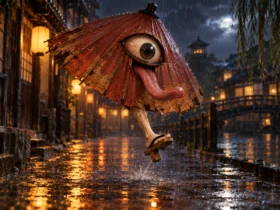
A yokai born from an old umbrella, with one eye, a long tongue and a single leg on which it hops about. A classic example of the tsukumogami (tool yokai), also called kasa-obake, it is a familiar figure in haunted houses.
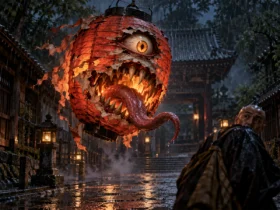
A yokai born from an old paper lantern, depicted with its torn part turned into a mouth, eyes appearing and a long tongue hanging out. Katsushika Hokusai's picture of Oiwa's face appearing on a lantern is also famous.
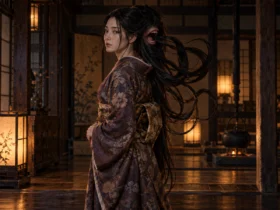
A female yokai with a second, large mouth on the back of her head. She is said to move her hair like hands to carry food to the mouth behind. She is known from the Edo-period Ehon Hyaku Monogatari and the folktale "The Wife Who Doesn't Eat."
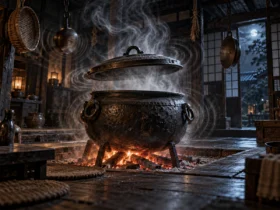
A Shinto ritual at Kibitsu Shrine in Okayama Prefecture in which fortunes are told by the sound of a cauldron, and the supernatural tales around it. It is known from "The Cauldron of Kibitsu" in Ueda Akinari's Ugetsu Monogatari, and Toriyama Sekien also drew it as a cauldron yokai.
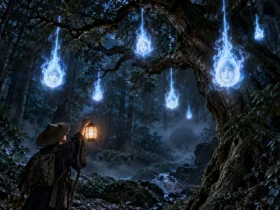
A pale, bluish fire yokai that bobs up and down on a night mountain road, as if hanging from a tree branch. A human face sometimes appears in the flame. Its name comes from moving up and down like a well bucket (tsurube).
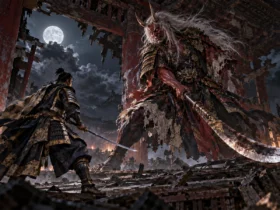
An oni said to be the chief follower of Shuten-doji, chief of the oni of Mount Oe. It is known for the legend in which Watanabe no Tsuna, one of Minamoto no Raiko's Four Heavenly Kings, cut off its arm, and it came back to retrieve it. It is a subject of Noh and kabuki.
A being said to have one body with two faces and four arms and four legs. The Nihon Shoki describes him as a bandit who defied the imperial court and was killed, but in the Hida region he is remembered as a hero who founded temples.
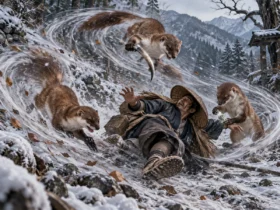
A yokai said to ride on whirlwinds and cut people's skin like a sickle. The cuts are said to be painless and barely bleed. One tradition says kamaitachi come in threes: one knocks you down, one cuts, and one applies medicine.
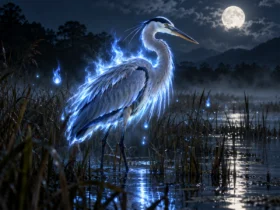
A mysterious fire in which the body of a grey heron seems to glow pale blue at night. It was said to be light given off by old grey herons or night herons, and Toriyama Sekien drew it too. One theory says it was feathers lit by the moon.
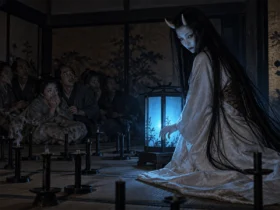
A demon-woman yokai said to appear when the hundredth story has been told at a hyakumonogatari ghost-story gathering. It comes from an Edo-period game of telling ghost stories by the light of an andon lamp covered with blue paper.
A female yokai in the form of a skeleton, who visits her beloved in the form she had in life. Toriyama Sekien drew her, and she is linked with the ghost story Botan Doro, in which Otsuyu, who visits a man every night, turns out to be a skeleton.
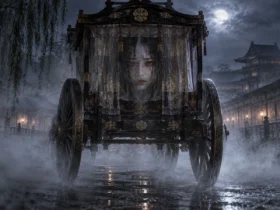
An ox-cart yokai with a giant face on its front that appears on nights when the moon is hazy. Drawn by Toriyama Sekien, it is said to be the grudge of a woman shamed in the "carriage quarrel" of The Tale of Genji, lodged in a carriage.
A yokai said to have appeared in the sea off Higo Province (Kumamoto) in 1846, predicting good harvests and an epidemic. It told people to draw its image and show it to others. In 2020 it went viral as a charm against disease.
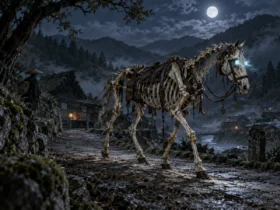
A yokai in the form of horse bones drawn in the Edo-period yokai scroll Tosa Obake Zoshi. It is said to be a horse that burned to death in a fire. It is also linked with the Japanese expression "horse bones from who knows where."
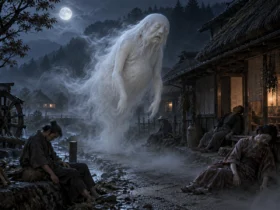
A mysterious yokai with a long, slender white body drawn in Edo-period yokai scrolls. What mischief it does is not recorded. Today it is sometimes said that anyone it possesses becomes absent-minded and loses all motivation.
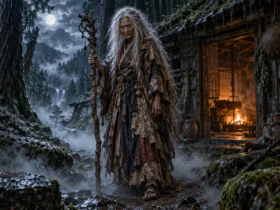
An old woman yokai who lives deep in the mountains. She is told of as a terrifying hag who eats people, yet she also appears as a mountain goddess and as the mother of Kintaro. She is familiar from folktales such as "The Three Charms."
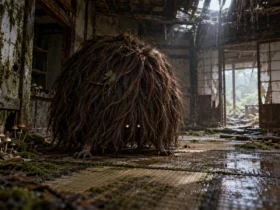
A hairy yokai covered all over in long hair. It lives in damp places such as under floors, and sickness is said to come to the house where it settles. Its name is also written with characters meaning "rarely seen."
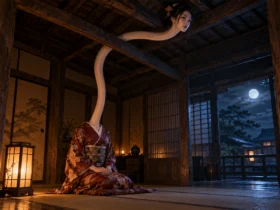
A female yokai whose neck stretches to great lengths at night. In the "nukekubi" type, the head detaches and flies around. It appears in Lafcadio Hearn's Kwaidan and was a popular sideshow attraction in the Edo period.
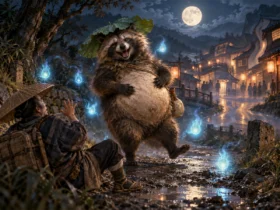
A tanuki (raccoon dog) yokai that tricks people and transforms into people and things. Legends of famous great tanuki abound in Shikoku and Sado, and it is beloved through folktales like Bunbuku Chagama and stories of tanuki drumming on their bellies.