Entries: 94

Yokai ★★★★★ Japan (Kyoto)

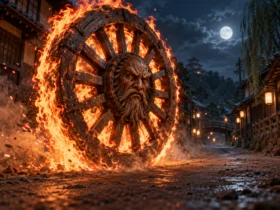
Wanyudo (Wheel Monk)

A yokai with a terrifying man's face in the center of a flaming ox-cart wheel. It is said to steal the soul of anyone who sees it, but cannot approach a house with a charm reading "This is the village of Shobo" on the door. Toriyama Sekien drew it.
Yokai ★★★★★ China

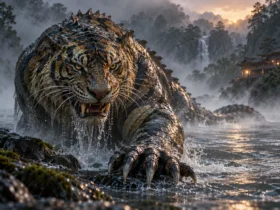
Suiko (Water Tiger)

A water yokai said to live in Chinese rivers, the size of a child and covered in hard scales. In Edo-period Japan it was treated as a relative or another name of the kappa, and a kappa encyclopedia called Suiko Koryaku was compiled.

Yokai ★★★★★ Japan (Sado Island, Niigata Prefecture)

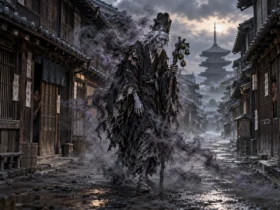
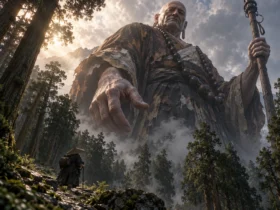
Miage-nyudo (Look-Up Monk)

A yokai that appears on a night slope in the form of a little monk and grows taller and taller as you look up. It is told of on Sado Island, Niigata Prefecture, and is said to vanish if you chant "Miage-nyudo, I saw over you" and lie face down. It is a relative of the mikoshi-nyudo.

Yokai ★★★★★ Japan

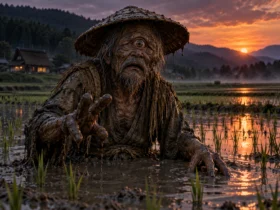
Dorotabo (Mud-Field Monk)

A one-eyed, three-fingered yokai that rises from a muddy rice field to the waist and cries "Give back my field!" It is said to appear because the son of an old man who left rice fields for his descendants betrayed his wishes by drinking and selling the fields.

Yokai ★★★★★ Japan (Tokyo)

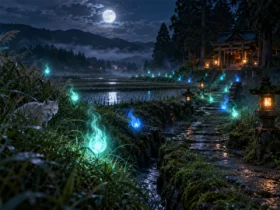
Kitsunebi (Fox Fire)

Ghostly balls of light that appear in rows, flickering across the fields and mountains at night. They were said to be lit by foxes and to be the lanterns of a fox wedding procession. At Oji Inari in Edo, foxes from all over the Kanto region were said to gather on New Year's Eve and light fox fires.

Yokai ★★★★★ Japan (Tokyo)

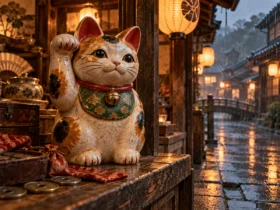
Maneki-neko (Beckoning Cat)

A cat figurine with one paw raised, beckoning customers and good fortune. A raised right paw is said to invite money, a raised left paw customers. Its origin is told in several stories, such as Ii Naotaka at Gotokuji Temple in Tokyo, and the lucky charm has spread worldwide.

Yokai ★★★★★ Japan (Saga Prefecture)

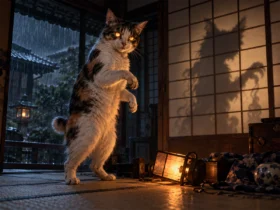
Bakeneko

A yokai cat that has lived long enough to gain supernatural powers, taking human form or cursing people. The "Nabeshima Bakeneko Disturbance" of Saga is especially famous, and bakeneko tales were hugely popular in Edo-period kabuki and storytelling.

Yokai ★★★★★ Japan

Kasha

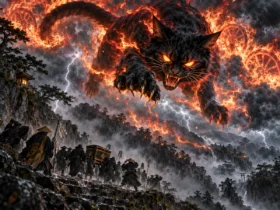
A yokai that appears at funerals and graveyards and steals the bodies of the dead. It is said to target the remains of those who did many evil deeds, and is often described as a cat yokai. Its name is said to come from the "fire cart" that carries sinners to hell.

Yokai ★★★★★ Japan (Gunma Prefecture)

Bunbuku Chagama

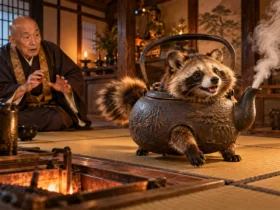
The legend of a magical tea kettle at Morinji Temple in Tatebayashi, Gunma Prefecture, that never ran out of hot water however much was drawn from it. The monk who used it turned out to be a tanuki. It later spread as the folktale of a tanuki that turned into a tea kettle and walked a tightrope.

Yokai ★★★★★ Japan (Iwate Prefecture)

Oshirasama

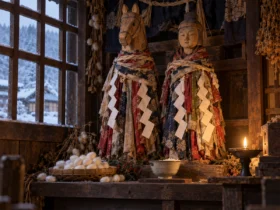
A household deity worshipped in old families of the Tohoku region: a pair of mulberry-wood figures with the faces of a horse and a girl, dressed in layers of cloth. The Legends of Tono records the tale of a tragic love between a horse and a girl from which silkworms were born.

Yokai ★★★★★ India

Rasetsu (Rakshasa)

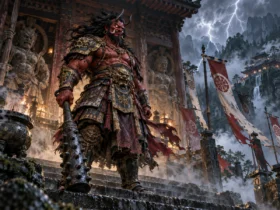
The man-eating demon Rakshasa of Indian mythology, as it came to Japan with Buddhism. It is a fearsome demon that deceives people and eats their flesh, yet it also became Rasetsu-ten, a protector of the Buddhist law after converting to Buddhism.

Yokai ★★★★★ Japan (Akita Prefecture)

Namahage

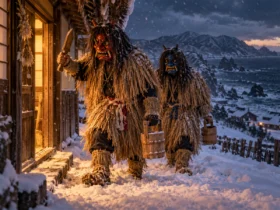
A visiting deity of a traditional New Year's Eve event on the Oga Peninsula in Akita Prefecture. Wearing demon-like masks and straw costumes called kede, Namahage go from house to house shouting "Are there any crybabies here?", scolding the lazy and bringing good fortune.

Yokai ★★★★★ Japan (Okinawa Prefecture)

Kijimuna

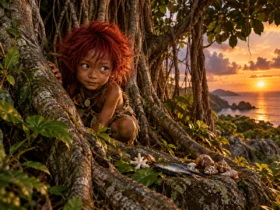
A yokai or spirit said to live in old banyan and other great trees in Okinawa. It looks like a red-haired child and loves fish eyes. If you befriend it, it helps you fish and makes your house rich, but if you betray it, it brings a curse.

Yokai ★★★★★ Japan

Tsukumogami

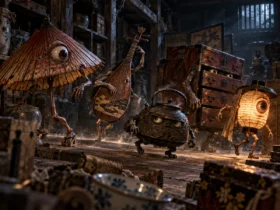
Tools and objects that have acquired a spirit after many years and become yokai. Tools used for a hundred years are said to transform. They are depicted in the Muromachi-period Tsukumogami-ki and in "night parade of a hundred demons" scrolls.

Yokai ★★★★★ Japan

Hannya

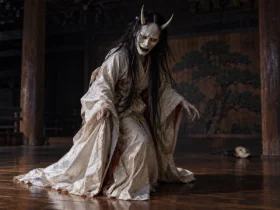
A Noh mask showing the face of a woman turned into a demon by jealousy and resentment, with two horns and a wide, gaping mouth. It is used in plays such as Aoi no Ue, which depicts the living spirit of Lady Rokujo from The Tale of Genji.

Yokai ★★★★★ Japan

Yakubyogami (God of Pestilence)

A god or yokai said to bring epidemics. People of the past thought outbreaks of disease were the work of the god of pestilence and drove it away with festivals and rituals. It is also the origin of the word "yakubyogami" for a person who brings trouble.

Yokai ★★★★★ Japan

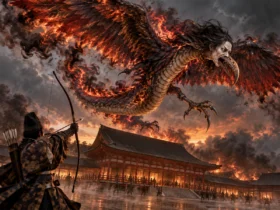
Itsumade

A monstrous bird that eerily cries "itsumade, itsumade" ("until when, until when"). The Taiheiki tells of one appearing over the palace in a year of epidemic and being shot down by a master archer. Toriyama Sekien named it "Itsumade" and drew it.

Yokai ★★★★★ Japan

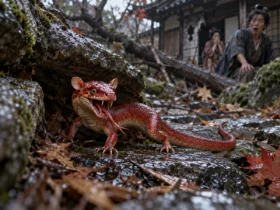
Shichihoda (Seven-Step Snake)

A tiny, deadly venomous snake whose bite kills before you can walk seven steps. It appears in Asai Ryoi's Edo-period Otogi Boko. Only about a dozen centimeters long, it looked like a dragon, it is said.

Yokai ★★★★★ Japan

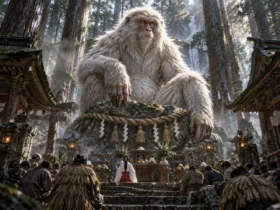
Sarugami (Monkey God)

A yokai in the form of an aged giant monkey living in the mountains, said to have made villagers offer girls as sacrifices. The Konjaku Monogatarishu tells of a hunter who defeated one. At the same time, monkeys have been revered as messengers of the mountain gods.

Yokai ★★★★★ Japan

Aburabo (Oil Monk)

A mysterious fire told of in Omi Province (Shiga Prefecture) and elsewhere. It is said to be a monk who stole lamp oil from a temple, wandering as a fireball after death. It was said to appear at the foot of Mount Hiei on summer nights.