Flying Humanoids
Flying cryptids shaped like people that seem to float through the air. Sightings and footage came one after another mainly in Mexico from the late 1990s. The leading theory is that they are balloons or kites.
Japanese yokai, cryptids, urban legends, UFOs, mythical beasts and ancient mysteries, translated into English.
Entries: 431
Flying cryptids shaped like people that seem to float through the air. Sightings and footage came one after another mainly in Mexico from the late 1990s. The leading theory is that they are balloons or kites.
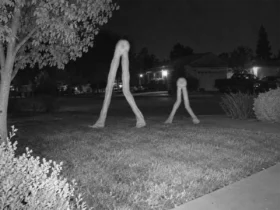
Strange creatures caught on a home security camera in Fresno, California, in 2007, looking like pairs of white pants walking by themselves. Their form, seemingly nothing but two long, thin legs, became a sensation.
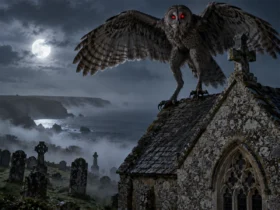
An owl-like monster as big as a human, sighted near the church in the village of Mawnan in Cornwall, England, in 1976. It was said to have glowing red eyes and sharp claws.
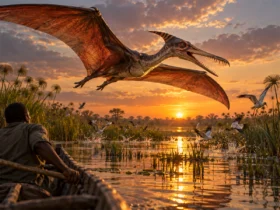
A pterosaur-like flying cryptid told of in the wetlands of Zambia in southern Africa. Its name is said to mean "overwhelmer of boats" in a local language. It was introduced in a book by an Englishman in the 1920s.
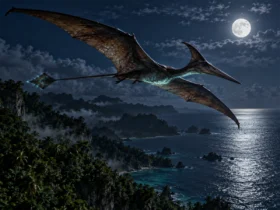
A flying cryptid that looks like a pterosaur, sighted on the islands of Papua New Guinea. It has a long tail and is said to glow at night. It drew attention as a possible surviving pterosaur.
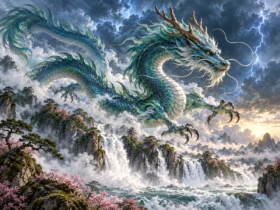
One of the Four Symbols, a sacred beast in the form of a blue dragon that guards the east. It governs spring and the element of wood. It is painted on the walls of the Takamatsuzuka and Kitora tombs and was built into the plan of the Heian capital.
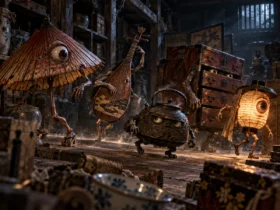
Tools and objects that have acquired a spirit after many years and become yokai. Tools used for a hundred years are said to transform. They are depicted in the Muromachi-period Tsukumogami-ki and in "night parade of a hundred demons" scrolls.
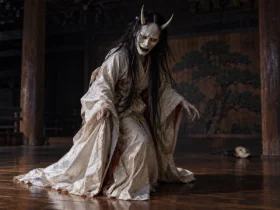
A Noh mask showing the face of a woman turned into a demon by jealousy and resentment, with two horns and a wide, gaping mouth. It is used in plays such as Aoi no Ue, which depicts the living spirit of Lady Rokujo from The Tale of Genji.
A god or yokai said to bring epidemics. People of the past thought outbreaks of disease were the work of the god of pestilence and drove it away with festivals and rituals. It is also the origin of the word "yakubyogami" for a person who brings trouble.
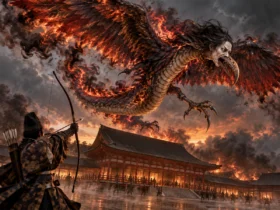
A monstrous bird that eerily cries "itsumade, itsumade" ("until when, until when"). The Taiheiki tells of one appearing over the palace in a year of epidemic and being shot down by a master archer. Toriyama Sekien named it "Itsumade" and drew it.
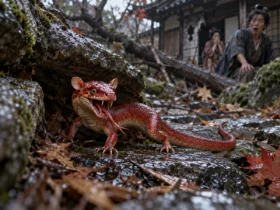
A tiny, deadly venomous snake whose bite kills before you can walk seven steps. It appears in Asai Ryoi's Edo-period Otogi Boko. Only about a dozen centimeters long, it looked like a dragon, it is said.
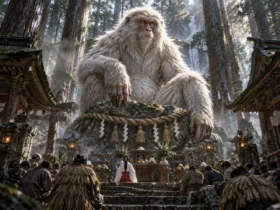
A yokai in the form of an aged giant monkey living in the mountains, said to have made villagers offer girls as sacrifices. The Konjaku Monogatarishu tells of a hunter who defeated one. At the same time, monkeys have been revered as messengers of the mountain gods.
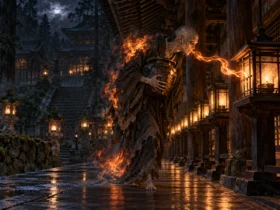
A mysterious fire told of in Omi Province (Shiga Prefecture) and elsewhere. It is said to be a monk who stole lamp oil from a temple, wandering as a fireball after death. It was said to appear at the foot of Mount Hiei on summer nights.
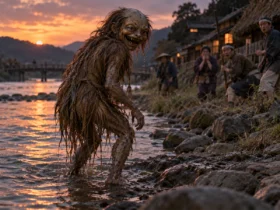
A kappa-like yokai told of in Saga Prefecture and elsewhere in Kyushu. It cries "hyo hyo," loves eggplants and ravages fields. Anyone who sees it is said to come down with a fever.
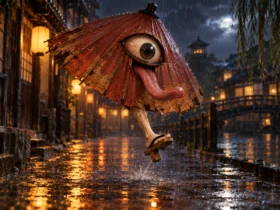
A yokai born from an old umbrella, with one eye, a long tongue and a single leg on which it hops about. A classic example of the tsukumogami (tool yokai), also called kasa-obake, it is a familiar figure in haunted houses.
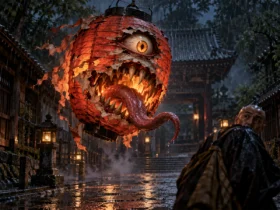
A yokai born from an old paper lantern, depicted with its torn part turned into a mouth, eyes appearing and a long tongue hanging out. Katsushika Hokusai's picture of Oiwa's face appearing on a lantern is also famous.
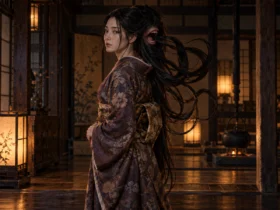
A female yokai with a second, large mouth on the back of her head. She is said to move her hair like hands to carry food to the mouth behind. She is known from the Edo-period Ehon Hyaku Monogatari and the folktale "The Wife Who Doesn't Eat."
A Shinto ritual at Kibitsu Shrine in Okayama Prefecture in which fortunes are told by the sound of a cauldron, and the supernatural tales around it. It is known from "The Cauldron of Kibitsu" in Ueda Akinari's Ugetsu Monogatari, and Toriyama Sekien also drew it as a cauldron yokai.
A pale, bluish fire yokai that bobs up and down on a night mountain road, as if hanging from a tree branch. A human face sometimes appears in the flame. Its name comes from moving up and down like a well bucket (tsurube).
An oni said to be the chief follower of Shuten-doji, chief of the oni of Mount Oe. It is known for the legend in which Watanabe no Tsuna, one of Minamoto no Raiko's Four Heavenly Kings, cut off its arm, and it came back to retrieve it. It is a subject of Noh and kabuki.