Megalodon
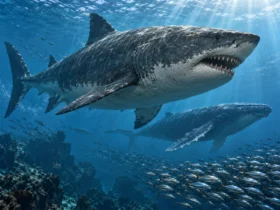
One of the largest sharks in history, reaching 15 m or more, thought to have gone extinct about 3.6 million years ago. Survival theories that it still lives in the deep sea are told as a cryptid story, but there is no scientific evidence.
Mystery Timeline|Undated myths and BC
Gods and mythical beasts of world mythology, ancient ruins and legends from before recorded history.
One of the largest sharks in history, reaching 15 m or more, thought to have gone extinct about 3.6 million years ago. Survival theories that it still lives in the deep sea are told as a cryptid story, but there is no scientific evidence.
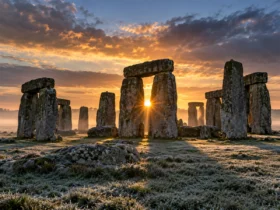
A prehistoric megalithic monument on Salisbury Plain in southern England, built in stages from around 3000 BC. Its stones are aligned with the midsummer sunrise, and who built it and why remain largely a mystery.
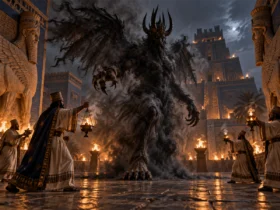
Spiritual beings believed in by the Sumerians and Babylonians of ancient Mesopotamia. There were both good guardian spirits and evil spirits, and many incantations to drive away evil utukku survive on clay tablets.
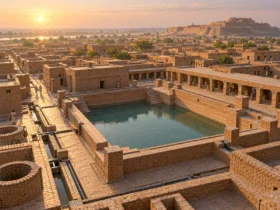
One of the largest city ruins of the Indus civilization, in the Indus River valley of Pakistan. Flourishing around 2500 BC, it was a planned city with grid streets, sewers and a great bath. Its script remains undeciphered, and it is also known for an urban legend that it was destroyed in an ancient nuclear war.
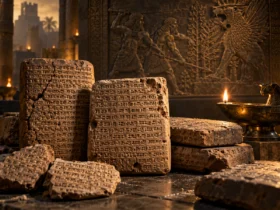
One of the oldest works of literature in the world, born in ancient Mesopotamia. It tells of Gilgamesh, king of Uruk, who defeats monsters with his friend Enkidu and, after his friend's death, travels in search of immortality. It includes a great flood story very similar to Noah's Ark.
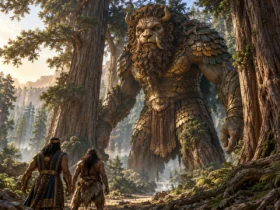
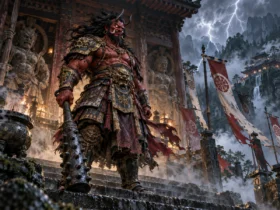
The monstrous guardian of the Cedar Forest in the Epic of Gilgamesh of ancient Mesopotamia. Ordered by the god Enlil to guard the forest, he had a terrifying face and seven radiant auras. He was slain by the hero Gilgamesh and his friend Enkidu.
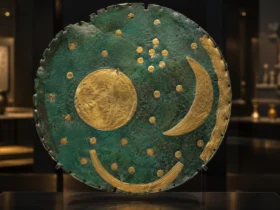
A bronze disc about 32 cm across, found near Nebra, Germany, with the sun (or full moon), a crescent moon and stars depicted in gold. Dated to around 1600 BC in the Bronze Age, it is one of the oldest concrete depictions of the cosmos in the world. The story from looting to recovery also drew attention.
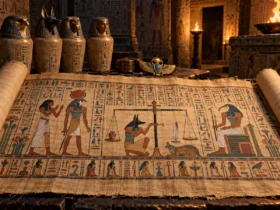
A collection of spells placed in tombs with mummies in ancient Egypt, so the dead could travel safely through the underworld and enter paradise. Written on papyrus, it is famous for the "final judgment" scene in which the dead person's heart is weighed against a feather on scales. Its original title was "The Book of Coming Forth by Day."
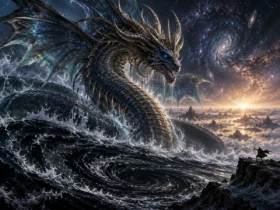
The primordial goddess of the sea in the Babylonian creation myth Enuma Elish. She created an army of monsters and fought the young gods, but was defeated by the hero god Marduk, who split her body in two to make heaven and earth.
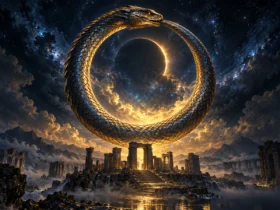
The image of a serpent (or dragon) that forms a circle by biting its own tail. Originating in ancient Egypt, it was handed down in alchemy and Gnosticism. Having no beginning and no end, it symbolizes infinity, eternity, and death and rebirth.
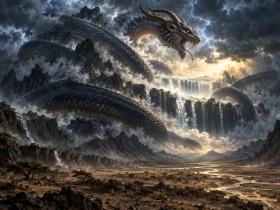
A giant serpent (dragon) in the Rigveda, the sacred text of ancient India. It dammed up the world's waters and brought drought, but was struck down by the thunder god Indra with his vajra. Its name is said to mean "the one who covers."
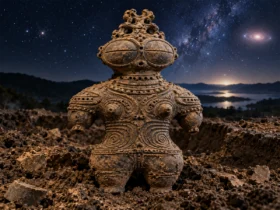
Clay figurines of the final Jomon period known for their huge eyes. The one from the Kamegaoka site in Tsugaru, Aomori Prefecture, is an Important Cultural Property of Japan. They became famous through the theory that they depict aliens in spacesuits.
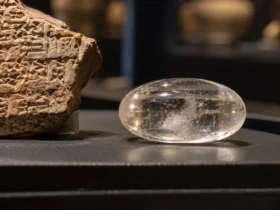
A piece of rock crystal from around the 8th century BC, found in 1850 in the palace ruins of Nimrud, a capital of ancient Assyria in today's Iraq. Because it works like a convex lens, it was hailed as an ancient magnifying glass or telescope. It is held at the British Museum. Some see it as part of an ornament.
Giants in Greek mythology with a single eye in the middle of the forehead. They are told of as master smiths who made Zeus's thunderbolts, while in the Odyssey the cyclops Polyphemus is a man-eating giant who captures and eats the hero Odysseus's men.
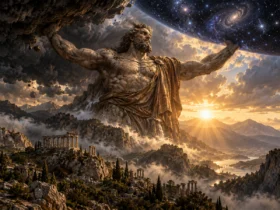
The race of giant gods who ruled the world before the Olympian gods in Greek mythology. Children of the sky god Uranus and the earth goddess Gaia, they were led by Cronus. They lost the ten-year war against Zeus and his siblings known as the Titanomachy.
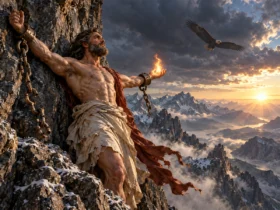
A Titan god of Greek mythology who stole the fire of the gods and gave it to humans, bringing civilization. As punishment, the angry Zeus chained him to a mountain where a great eagle pecked at his liver every day, until he was rescued by the hero Heracles.
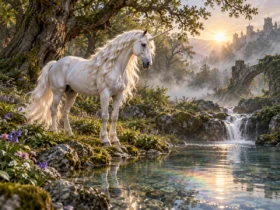
A horse-like creature with a single long horn on its forehead. It appears in ancient Greek records, and in medieval Europe it was a holy beast that only a pure maiden could capture. Its horn was believed to neutralize poison and was traded at high prices.
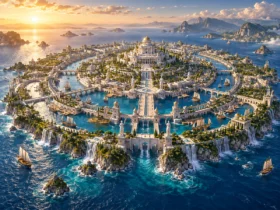
A great island nation said to have sunk into the sea in a single day and night, described by the ancient Greek philosopher Plato in his dialogues. Many theories about whether it really existed are still debated.
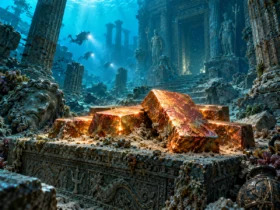
The legendary metal said by Plato to have been mined in Atlantis, glowing red like fire. One theory says it was a copper alloy such as brass, and in 2015 ingots of an alloy were found in a shipwreck.
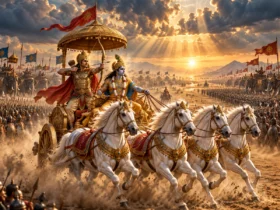
One of the two great epics of ancient India, a story of a great war between royal houses and one of the longest stories in the world. It is also known for descriptions of the divine weapon Brahmastra, which have been called "ancient nuclear weapons."
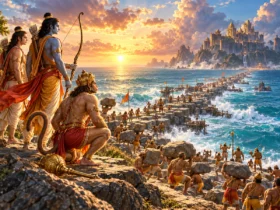
One of the two great epics of ancient India: the adventure of Prince Rama, who rescues his abducted wife Sita. It features the flying vehicle vimana, spread across Asia, and is said to have influenced Sun Wukong of Journey to the West.
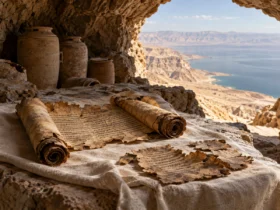
Ancient manuscripts discovered in 1947 by a shepherd boy in caves at Qumran by the Dead Sea. Dating from about the 3rd century BC to the 1st century AD, they include some of the oldest surviving manuscripts of the Old Testament and have been called "the greatest archaeological discovery of the 20th century."
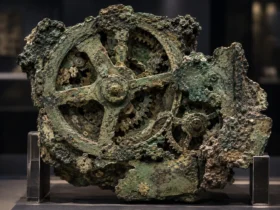
A bronze geared device from around the 2nd–1st century BC, recovered in 1901 from a shipwreck off the Greek island of Antikythera. An astronomical calculator that could predict the movements of the sun and moon and eclipses, it is called "the world's oldest computer." It is a genuine ancient artifact.
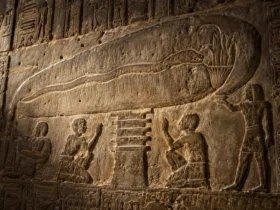
A relief carved on the wall of a crypt in the Temple of Hathor at Dendera, Egypt, that looks like a giant light bulb. It was hailed as "proof of electricity in ancient Egypt," but Egyptologists read it as a mythological scene of a snake born from a lotus flower.
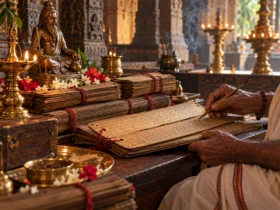
A legendary book of prophecy said to have been written on palm leaves by the ancient Indian sage Agastya, foretelling the fates of the people who would visit. In Tamil Nadu in southern India, there are "Nadi reading" houses where people have their own leaf found by their thumbprint and read to them.
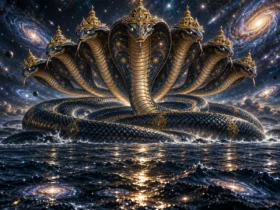
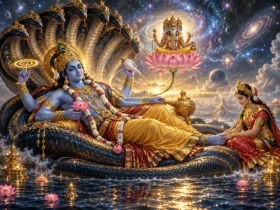
The king of serpents with countless heads in Indian mythology, also called Shesha. He serves as the bed on which the god Vishnu sleeps in the primordial ocean and is said to support the world. His name means "endless."
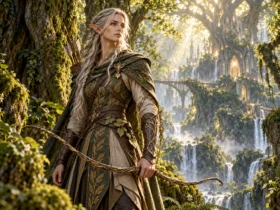
A fairy people rooted in Norse mythology, said to include light elves and dark elves. Tolkien's The Lord of the Rings created the standard fantasy image of a long-lived, beautiful race.
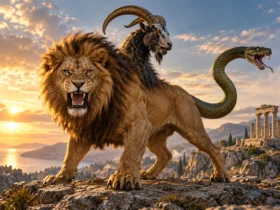
A monster of Greek mythology with a lion's head, a goat's body and a serpent's tail, which breathes fire. It ravaged Lycia in Asia Minor but was slain by the hero Bellerophon riding the winged horse Pegasus. It is the origin of the word "chimera," a combination of different creatures.
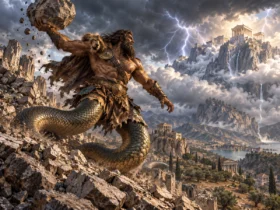
The race of giants in Greek mythology. Born from Gaia, goddess of the earth, they challenged the Olympian gods to battle (the Gigantomachy). The gods won with the help of the human hero Heracles. They are said to be the origin of the English word "giant."
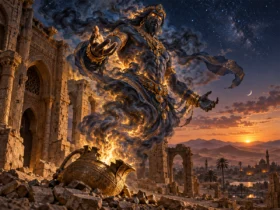
Spiritual beings in Arabian folklore and Islam, said to have been created from smokeless fire. Also known as the genie of the lamp in the Thousand and One Nights, they are called "genies" in English.
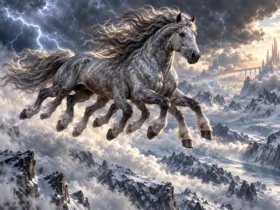
The eight-legged grey divine horse ridden by Odin, chief god of Norse mythology. The fastest of all horses, it races across sky, land and sea and can even go to the land of the dead. It is also a child of the trickster god Loki.
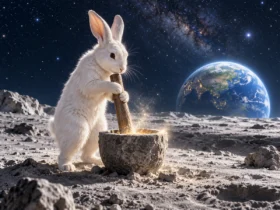
The tradition of seeing a rabbit in the markings of the moon. In Japan it pounds rice cakes (mochi); in China it makes the elixir of immortality. An Indian Buddhist tale says a rabbit that offered itself was painted on the moon.
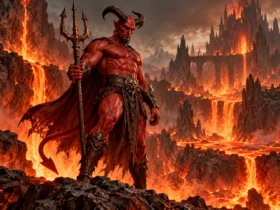
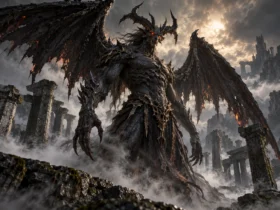
In Christianity, the leader of evil who opposes God and tempts people toward evil. Also called Satan or Lucifer, he is said to have originally been an angel serving God who was cast out of heaven for his pride, a "fallen angel." The image with horns, a tail and bat wings became established in art from the Middle Ages on.
A word for devils and evil spirits. It comes from the ancient Greek "daimon," a spiritual being between gods and humans. As Christianity spread, it came to mean evil spirits opposed to God, and it often refers to the many devils who serve Satan (the Devil), leader of the fallen angels.
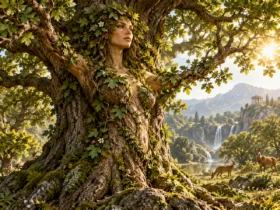
A tree spirit (nymph) of Greek mythology, said to live especially in oak trees. The hamadryad, who shares her life with a tree, is said to die when the tree dies.
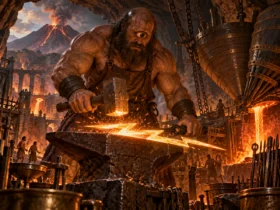
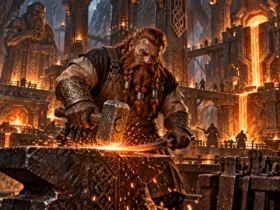
In Norse mythology, a race of master smiths who live underground and inside rocks. They are said to have made the gods' weapons, such as Mjolnir and Gungnir. In fantasy, they are the classic stubborn, bearded craftsmen.
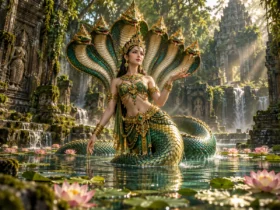
Serpent gods and spirits of Indian mythology, depicted as human above and snake below, or as a cobra with many heads. In Buddhism they became protectors of the Dharma, and in China and Japan they were translated as "dragons."
One of the mightiest weapons in the Indian epic Mahabharata, imbued with the power of the god Vishnu. Its description of countless fiery arrows burning everything is cited as evidence for the ancient nuclear war theory.
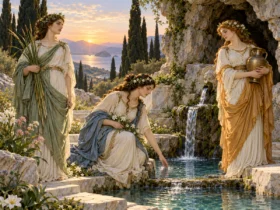
The general name for nature spirits in Greek mythology. They dwell in springs, rivers, the sea, mountains and trees in the form of young, beautiful women. There are many kinds, including naiads, nereids and dryads.
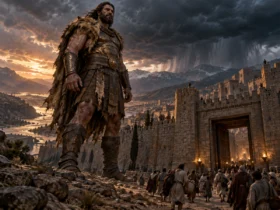
Mysterious giants in Genesis and other books of the Old Testament. They are said to be the children of the "sons of God" and human daughters, and in the Book of Enoch they are the children of fallen angels. Said to have been destroyed by Noah's Flood, they are a subject of giant legends.
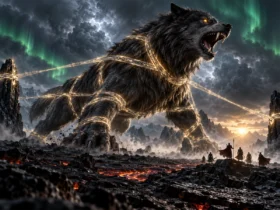
A giant wolf in Norse mythology, the son of the god Loki. Feared by the gods, he was bound with the magic fetter Gleipnir. He is foretold to swallow the chief god Odin at Ragnarok, the end of the world.
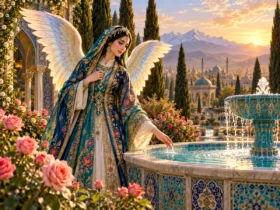
A beautiful winged spirit of Persian (Iranian) folklore. Once considered evil, peris later became symbols of goodness and beauty. They are known for stories of trying to return to paradise.
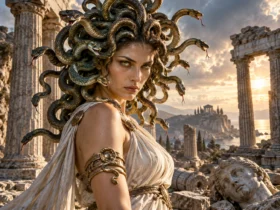
One of the three Gorgon sisters of Greek mythology. Her hair is a mass of snakes, and anyone who looks into her eyes is turned to stone. The hero Perseus cut off her head, and from her blood the winged horse Pegasus was born. Her head was placed on the goddess Athena's shield to ward off evil.
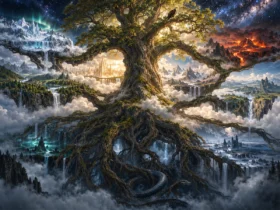
In Norse mythology, the giant ash tree, the "World Tree," that rises through the nine worlds. At its roots is a well where the goddesses of fate live, and the chief god Odin hung from it to win the secret of the runes. It witnesses the world from beginning to end.
In Norse mythology, the primordial giant who appeared first, before the world was born. Ancestor of the frost giants, he was killed by Odin and his two brothers, and the world, including earth, sea, sky and mountains, was made from his body.
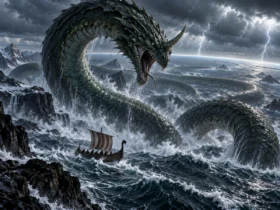
A serpent in Norse mythology so huge it encircles the world. A child of the evil god Loki and brother of Fenrir, he was thrown into the sea and grew until he surrounded the human world, biting his own tail. At Ragnarok, the final battle, he and the thunder god Thor kill each other.
The man-eating demon Rakshasa of Indian mythology, as it came to Japan with Buddhism. It is a fearsome demon that deceives people and eats their flesh, yet it also became Rasetsu-ten, a protector of the Buddhist law after converting to Buddhism.
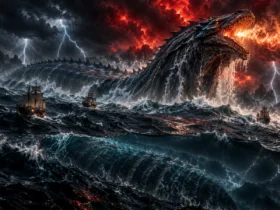
A giant sea monster in the Old Testament. Described as the mightiest creature God made, it breathes fire, and no weapon can harm it. It was later linked with demons and became the title of Hobbes's work of political philosophy.
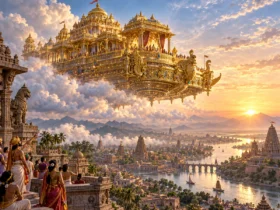
Flying palaces and vehicles that appear in the epics and myths of ancient India. Some claim they prove ancient aircraft existed, but the text said to describe them has been shown to be a 20th-century work.